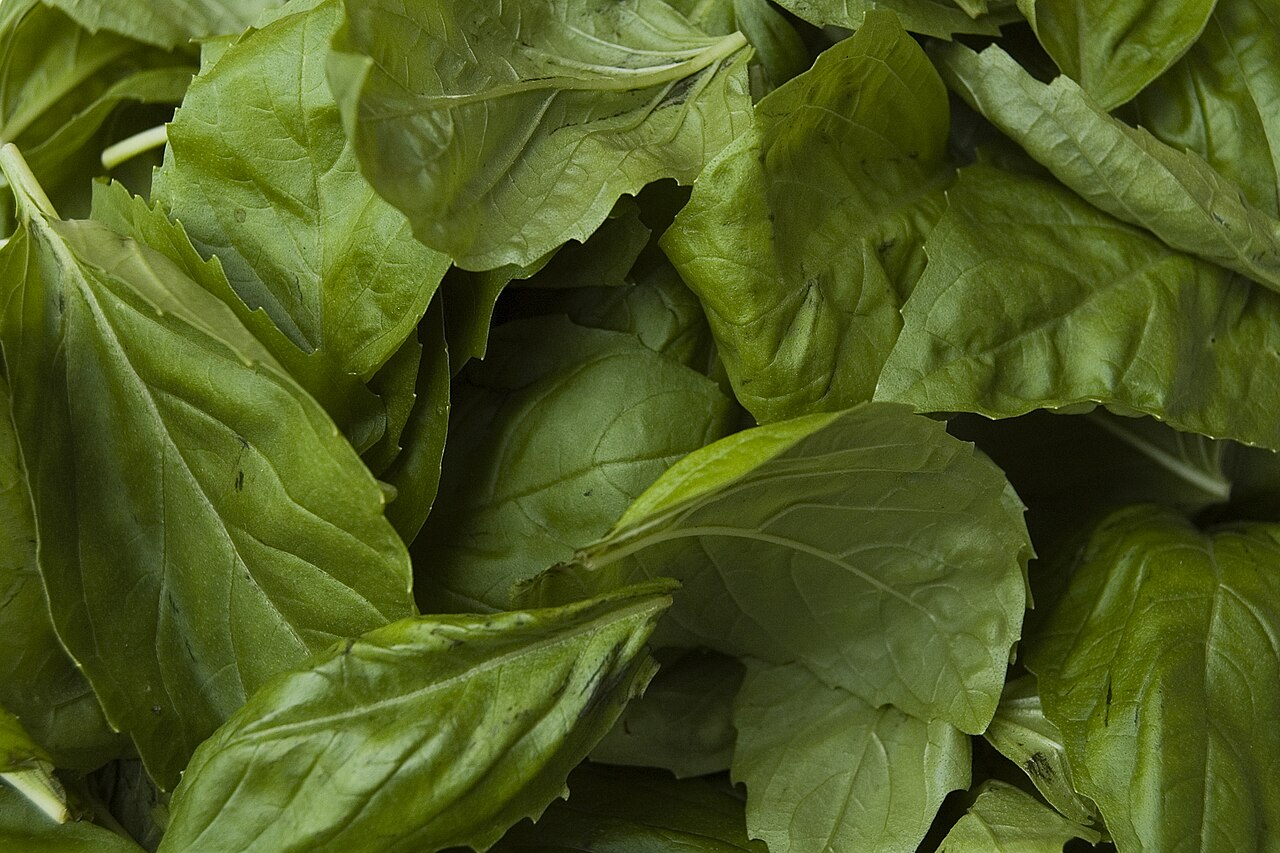
This story is sweet basil, Ocimum basilicum — not holy basil / Tulsi, which UC and Kew treat as a different species.
How it was found
Kew maps Ocimum basilicum from tropical and subtropical Asia to northern Australia. The native list includes India, Sri Lanka, Nepal, Bangladesh, the Himalaya, much of mainland and island Southeast Asia, Taiwan, China South-Central and Southeast, New Guinea, Queensland, and Western Australia (plus the Andaman and Nicobar Islands). The species is introduced widely in Africa, the Americas, Pacific islands, and parts of Europe.
USDA GRIN does not print a native-country table. It lists the species as widely cultivated and notes “possible origin Africa” (citing Ryding 1994). That African note is not Kew’s Asia-to-Australia map.
UC Master Gardener pages disagree with each other and with Kew. UCCE Riverside writes that basil originated from India at least 5,000 years ago. UCCE San Luis Obispo calls it a 5,000-year-old culinary herb native of India, Africa, and Asia. Sonoma Master Gardeners write that it originated in Africa and southern Asia — India, Thailand, and Vietnam. Kew does not print a first-cultivation country. No single origin is treated as settled here.
How people used it
Kew lists food. UC Master Gardeners treat basil as a culinary herb of the mint family (Lamiaceae), used fresh or dried. Sweet basil is a basic pesto ingredient, and UC pages name it in Italian, Thai, and Vietnamese cooking (Riverside, SLO, and Sonoma). UC Marin: the leaves, flowers, and seeds have culinary uses.
Kew lists the species as a medicine without naming a remedy. GRIN lists folklore medicines; those details are not copied. A Riverside fact sheet mentions centuries of medicinal use (headache) citing a non-Tier-1 site — skipped here. No fiber use showed up on the fetched pages.
Timeline
-
At least 5,000 years ago (as printed by UCCE)
A long culinary herb — origin disputed
UCCE Riverside Master Gardeners write that basil originated from India at least 5,000 years ago. UCCE SLO calls this 5,000-year-old culinary herb a member of the mint family. GRIN’s possible African origin and Kew’s broader Asia-to-Australia native range are not the same statement. The 5,000-year wording is UC’s, not Kew/GRIN consensus.
UCCE Riverside basil fact sheet; UCCE SLO
-
Early Greeks (as printed)
The fragrant herb of royalty
UCCE SLO Master Gardeners write that the genus name Ocimum is derived from a Greek verb meaning “to be fragrant,” and that early Greeks considered basil the herb of royalty. That is a name-and-status story, not a first-cultivation date.
UCCE SLO Master Gardeners — Basil
-
1753
Named in Species Plantarum
Kew accepts Ocimum basilicum L., first published in Species Plantarum (GRIN: Sp. pl. 2:597. 1753). That is sweet basil. Holy basil / Tulsi is a different species on the SLO page (Ocimum sanctum; Kew accepts that as Ocimum tenuiflorum).
Kew POWO; USDA GRIN
Cool to know
Basil is often thought of as Italian or Mediterranean. Sonoma UCCE Master Gardeners write that it originated in Africa and southern Asia (India, Thailand, and Vietnam). The pesto story is use. The origin story on UC pages points east and south.
UC Master Gardener Program of Sonoma County
The genus name Ocimum is from a Greek verb meaning “to be fragrant.” That is why the plant reads as perfume in a bed before it reads as a country of origin.
UCCE SLO Master Gardeners
USDA GRIN common names include basil and sweet basil. Economic uses listed include food-additive flavoring/spice and essential oils, matching the culinary use on UC pages.
USDA GRIN
UC IPM: many varieties of this culinary herb are grown in California, including sweet, purple, Greek, Italian, lemon, cinnamon, and Thai basil. Present cultivation, not a first-arrival date — Kew’s introduced list does not include California, and no Mission year was printed.
UC IPM — Basil
UCCE SLO Master Gardeners: over 60 varieties are grown and feature aromas such as lemon mint, cinnamon, camphor, licorice and more depending on the varietal.
UCCE SLO Master Gardeners — Basil
Growing notes for this plant live on the Plant Wiki. This page is origin and use, not a How-To.
Want basil in a San Diego pot? See the easy-herbs guide for keeping culinary basil going. Get a quote or write yourgardenofgold@gmail.com.