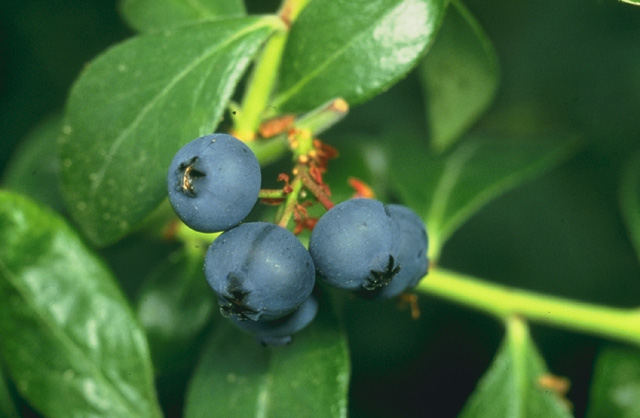
Stay genus-level. Highbush (Vaccinium corymbosum), lowbush (V. angustifolium), and rabbiteye (V. ashei) are printed as commercial examples — not this card’s binomial.
How it was found
Kew prints the native range of Vaccinium as cosmopolitan. The native list is worldwide (temperate and tropical mountains on many continents); Kew also prints doubtfully present in Algeria and Fiji, and introduced into South Georgia. No single native country is printed at genus rank.
Domestication is skipped at genus rank. Fetched pages do not print a first-domestication date or center for Vaccinium as a genus. UC California Agriculture (2005) prints commercial-type examples with regional natives — those are examples inside the genus, not this card’s species identity.
With improved low-chill cultivars from the 1970s through the 1990s, blueberry production expanded to the southern United States and then California. Breeders in the southeastern United States developed “low chill” southern highbush cultivars by crossing northern highbush species with native Florida species — as that 2005 page prints it.
How people used it
UC California Agriculture (Jimenez et al. 2005): blueberry is treated as a fruit crop (fresh and processed); family Ericaceae. Kew’s genus page does not print a use-class sentence at genus rank.
Timeline
-
1753
Linnaeus names the genus
Kew accepts Vaccinium L., first published in Species Plantarum: 349 (1753). Native range printed as cosmopolitan. Kew lists 493 accepted species on the fetched page. That is a genus, not a blueberry species card.
Kew POWO — Vaccinium L.
-
Commercial types as examples (as printed, not card identity)
Highbush, lowbush, rabbiteye
UC California Agriculture: highbush blueberries (Vaccinium corymbosum) and low-bush blueberries (Vaccinium angustifolium) are important commercial types and are native to the northeastern United States. Rabbiteye blueberries (Vaccinium ashei) are also produced commercially and are native to the southeastern United States. Example species inside the genus — not this wiki card’s binomial.
UC California Agriculture (Jimenez et al., 2005)
-
1970s through the 1990s (as printed)
Low-chill types open the South and California
UC California Agriculture: with the development of improved low-chill cultivars from the 1970s through the 1990s, blueberry production expanded to the southern United States and then California. Breeders in the southeastern United States developed “low chill” southern highbush cultivars by crossing northern highbush species with native Florida species.
UC California Agriculture (Jimenez et al., 2005)
-
2003 / California harvest window (as printed 2005)
A new California specialty crop
UC California Agriculture: in 2003 North American blueberry acreage exceeded 65,000 acres (North American Blueberry Council 2004, as cited). California harvest typically begins in early May and lasts almost 8 weeks. California acreage in that table: 1,300 acres (2003 estimate).
UC California Agriculture (Jimenez et al., 2005)
Cool to know
Kew does not give a single native country for the genus; it prints cosmopolitan. A blueberry origin story that names one nation at genus rank is inventing a fact.
Kew POWO
UC California Agriculture: blueberry is in Ericaceae with azaleas and rhododendrons; acid-loving (optimum soil pH printed as 4.0 to 5.2, citing Strik et al. 1993 on that page). Highbush plants are woody, shallow-rooted perennial shrubs.
UC California Agriculture (Jimenez et al., 2005)
“Northern highbush” vs “southern highbush” on the UC page refers to chilling requirement of cultivars, not to two wiki identities. Most northern highbush cultivars require more than 1,000 chill hours (Gough 1991, as cited there); southern highbush low-chill types 150 to 600 chill hours.
UC California Agriculture (Jimenez et al., 2005)
Growing notes for this plant live on the Plant Wiki. This page is origin and use, not a How-To.
Want blueberries in a San Diego bed? See the berries How-To — this story does not assign a species. Get a quote or write yourgardenofgold@gmail.com.