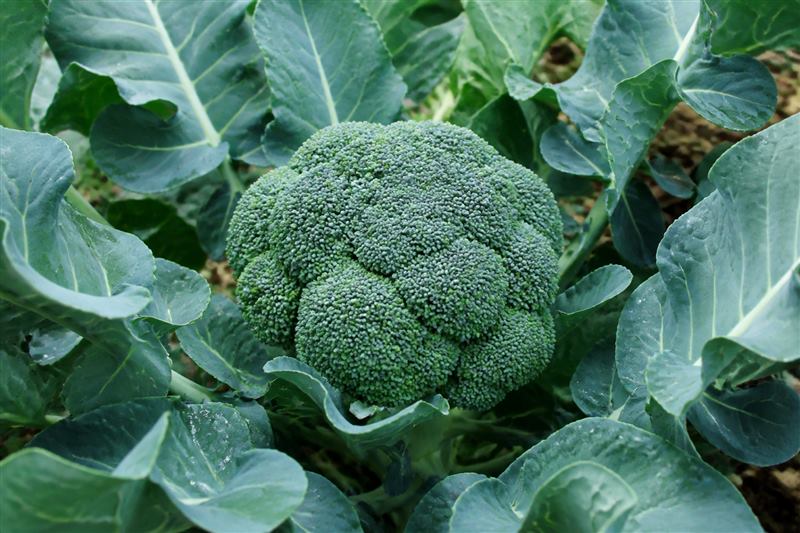
Italica / var. italica is a cultivar group, not a species. Broccoli raab and broccolini are not this card. Do not borrow cabbage’s 12th-century Germany line.
How it was found
Kew maps Brassica oleracea on Atlantic coasts of Great Britain, France and Spain. Native list: France, Great Britain, Spain. Kew Species Profile also says native to the Mediterranean region and southwestern Europe, as far north as southern England, found wild on seaside cliffs, and lists a distribution of France, Italy, Spain, United Kingdom — Italy is on that profile distribution sentence, not on the taxon Native to list. USDA GRIN native rows: United Kingdom (coasts), France (west and north coasts), Spain (north coast), and Germany (Schleswig-Holstein). GRIN Germany and the profile’s Italy are not added onto Kew’s Native to list. GRIN treats B. oleracea var. italica Plenck (Broccoli Group) as cultivated only.
Kew Species Profile (species rank, not broccoli-only): Brassica oleracea has been cultivated for at least 2,000 years, possibly much longer; cabbage, kale, kohlrabi, cauliflower, broccoli and Brussels sprouts are all cultivars of B. oleracea. Kew Italica Group (purple sprouting, sprouting broccoli): became popular in northern Europe in the 18th century. UC ANR Broccoli Production in California: broccoli (Brassica oleracea L. var. italica) has been grown in Europe for centuries but became an important U.S. vegetable crop only since 1925; commercial California broccoli is hybrids of the Italian green type (green sprouting broccoli or calabrese). UC Sonoma MG: under cultivation in Europe for centuries; planted as a commercial crop in California in the 1920s.
How people used it
Kew lists food (also animal food, environmental uses). Kew Species Profile: Brassica vegetables eaten globally; Italica Group bears edible inflorescences not compacted into a single head; Botrytis Group (broccoli, cauliflower, calabrese) bears edible inflorescences in compact heads. UC IPM: immature flower heads are harvested; a portion of the stem is also edible. GRIN Broccoli Group: human food — vegetable (flower buds).
Kew lists medicine and poison with no specific broccoli folk recipe. Kew Species Profile mentions glucosinolates and alleged anti-cancer activity for Italica Group; that is not copied as a verified remedy. GRIN folklore is not copied.
Timeline
-
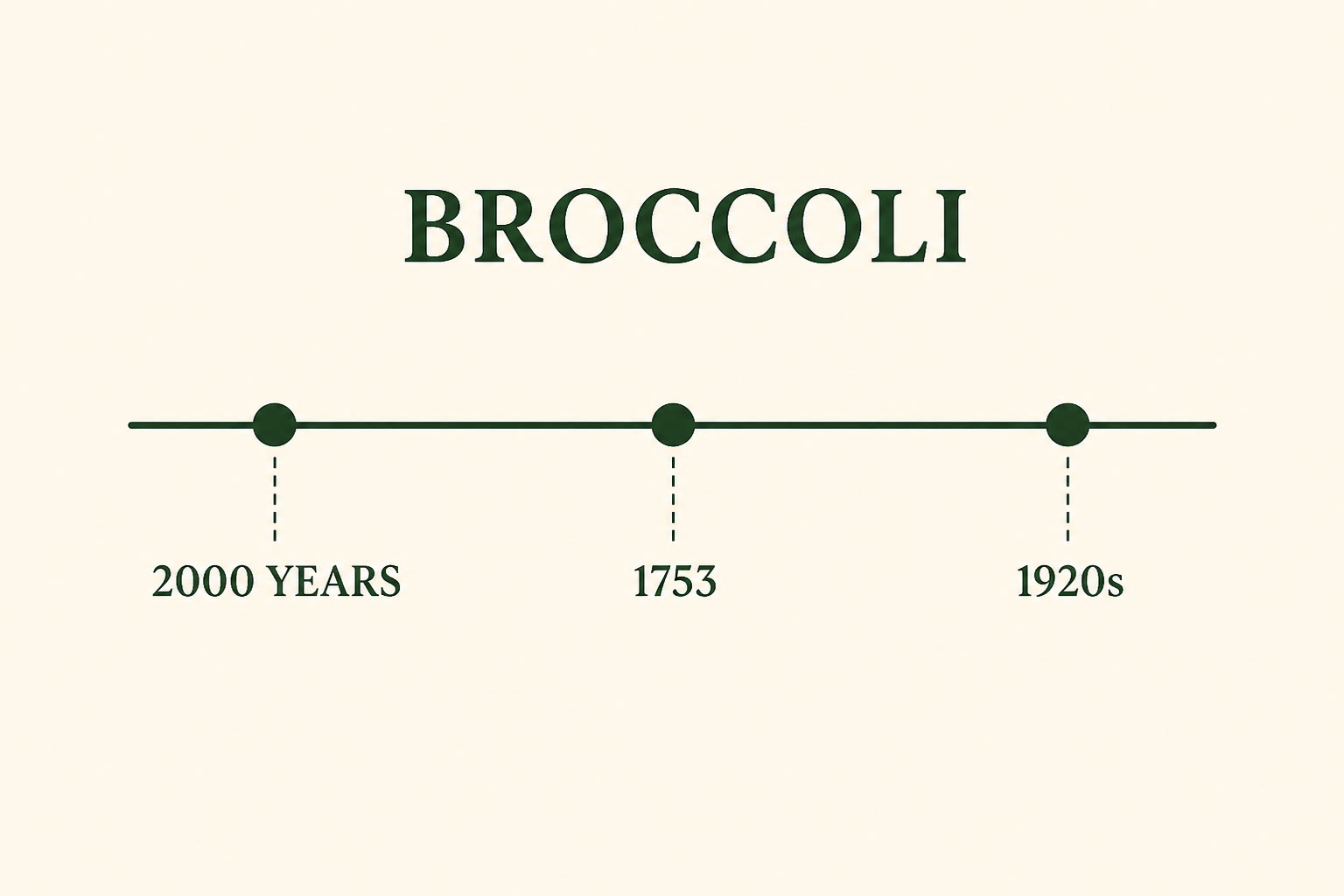
At least 2,000 years (species cultivation, Kew)
The whole cole family, not broccoli-only
Kew Species Profile: B. oleracea has been cultivated for at least 2,000 years, possibly much longer; a wide variety of forms developed. This is printed at species rank (cabbage/kale/cauliflower/broccoli/Brussels sprouts all cultivars), not as a broccoli-only first date. Kew’s Capitata “developed in Germany by the 12th century” is cabbage, not this card.
Kew POWO Species Profile — Brassica oleracea
-
18th century (Italica Group, Kew)
Sprouting broccoli in northern Europe
Kew Species Profile: Italica Group (purple sprouting, sprouting broccoli) became popular in northern Europe in the 18th century. Kew’s separate Botrytis Group also lists broccoli/calabrese; the two group names are not collapsed.
Kew POWO Species Profile
-
1753 / 1794
Species 1753, Broccoli Group 1794
Kew accepts Brassica oleracea L., first published in Sp. Pl.: 667 (1753). Kew treats B. oleracea var. capitata L. and var. gongylodes L. as synonyms of the species (not as separate species). USDA GRIN still maintains B. oleracea var. italica Plenck (Icon. pl. med. 6:29, t. 534. 1794) as Broccoli Group, cultivated only.
Kew POWO; USDA GRIN
-
1925 / 1920s
California makes it a U.S. crop
UC ANR Broccoli Production in California: important as a U.S. vegetable crop since 1925. UC Sonoma Master Gardeners: planted as a commercial crop in California in the 1920s, where it is now grown nearly exclusively (as printed). All commercial California broccoli are hybrids of the Italian green type, also called green sprouting broccoli or calabrese.
UC ANR Broccoli Production in California; UC Sonoma MG
Cool to know
Kew accepted name is Brassica oleracea L. UC IPM: Brassica oleracea var. italica. GRIN: B. oleracea var. italica Plenck = Broccoli Group. UCCE Sonoma cabbage page: cole crops in this species include broccoli, cauliflower, Brussels sprouts, collard greens, kohlrabi, and kale.
Kew POWO; UC IPM; USDA GRIN; UCCE Sonoma
Kew Species Profile lists eight cultivar groups of B. oleracea. Italica = purple sprouting / sprouting broccoli; Botrytis = broccoli, cauliflower, broccoflower, calabrese; Acephala = kale/collards; Capitata = cabbage; Gemmifera = Brussels sprouts; Gongylodes = kohlrabi. Do not borrow Acephala or Capitata history for the broccoli card.
Kew POWO Species Profile
UC Sonoma MG: avoid confusing broccoli raab/rapini (mustard family) and broccolini (a cross between broccoli and Chinese broccoli) with this crop. Turnip/bok choy (B. rapa) are not B. oleracea.
UC Sonoma Master Gardeners — Broccoli
Growing notes for this plant live on the Plant Wiki. This page is origin and use, not a How-To.
Want broccoli in a San Diego bed? See the fall-garden How-To for cool-season timing here. Get a quote or write yourgardenofgold@gmail.com.