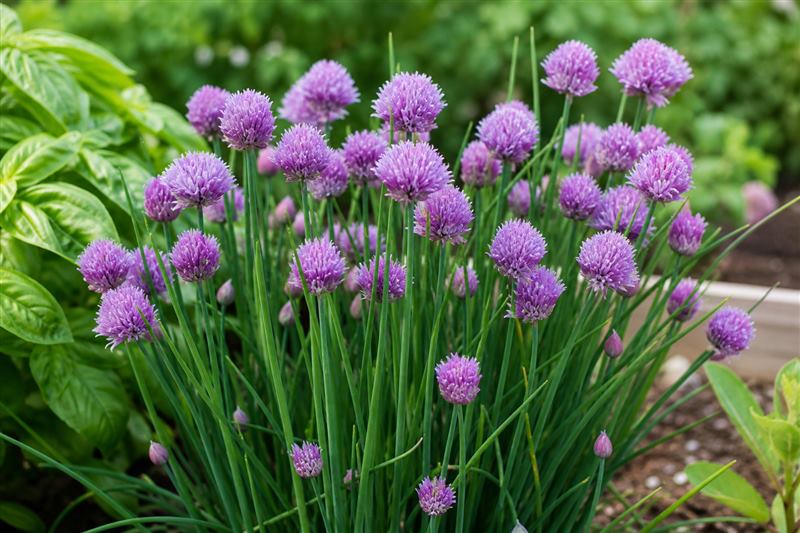
This card is Allium schoenoprasum, onion chives. Garlic chives are Allium tuberosum: mild garlic-like flavor and white flowers.
How it was found
Kew maps Allium schoenoprasum across the temperate Northern Hemisphere. The native list is broad across temperate Europe, Asia, and North America (including Alaska and many Canadian provinces and northern U.S. states; also Iran, Iraq, Türkiye, Japan, Korea, and much of Siberia). Introduced list includes Argentina South, Azores, Belgium, parts of the Caribbean, Illinois, Ireland, Maryland, Newfoundland, and others. USDA GRIN’s native table is similarly circumpolar-temperate and notes the species is also cultivated. UC Sacramento MG: found across much of Europe, Asia and North America.
No fetched page printed a first-domestication year or a single domestication center, and none printed a California or Mission arrival. UC Marin Master Gardeners write that chives have been used as a medicinal and culinary plant for thousands of years — printed as a duration, not a dated first-domestication event. Kew prints a temperate Northern Hemisphere native range (wild). UC pages treat it as a cultivated culinary herb without a first-cultivation date.
How people used it
Kew: used as a poison and a medicine and for food. UC Santa Clara MG: grown for edible leaves and flowers; leaves used to flavor salads, dips, soups, vinegars, egg/cheese dishes, sour cream, and butter; milder than other onion-family members; best used raw. GRIN: food additives — flavoring (leaves as herb, spice). UC Marin MG: add to eggs, baked potatoes, spreads, and salads, or use the purple flowers to infuse vinegar or as an edible garnish.
Kew lists medicine with no specific remedy named. GRIN folklore is not copied. UCCE Riverside’s Medical News Today health-benefit line is skipped. UCCE Riverside MG: chives, onions, garlic, and leeks are poisonous to dogs and cats at sufficient dose (as printed).
Timeline
-
Thousands of years (as printed; no first-cultivation year)
Medicinal and culinary — a duration
UC Marin Master Gardeners write that chives have been used as a medicinal and culinary plant for thousands of years. That is a span, not a dated first-domestication event and not a California arrival. Kew still prints a wild temperate Northern Hemisphere range rather than a crop-origin year.
UC Marin Master Gardeners — Underdog herbs for the home cook
-
1753
Named in Species Plantarum
Kew accepts Allium schoenoprasum L., first published in Species Plantarum: 301 (1753). USDA GRIN: Sp. pl. 1:301. 1753. Marin’s page misspells the binomial as Allium schoenprasum; this card stays on Kew’s spelling.
Kew POWO; USDA GRIN
-
Temperate Northern Hemisphere (as printed)
A bulbous northern herb
Kew: native range temperate Northern Hemisphere; bulbous geophyte of the temperate biome. UC Sacramento Master Gardeners: chives are a bulb-forming perennial herb found across much of Europe, Asia and North America.
Kew POWO; UC Master Gardeners of Sacramento County
-
Culinary herb (UC cards, as printed)
Leaves, flowers, mild onion
UC Santa Clara MG: Allium schoenoprasum, or onion chives; slender leaves from an underground bulb; 1-inch spherical purple flowers. UCCE Riverside MG: onion chives have a mild onion flavor and pink flowers; flowers and foliage are edible.
UC Santa Clara; UCCE Riverside
Cool to know
This card is onion chives (A. schoenoprasum), not garlic chives. UC Santa Clara, UC Sacramento, and UCCE Riverside all print garlic chives as Allium tuberosum: mild garlic-like flavor and white flowers. Do not mix onion, garlic, or elephant garlic into this card.
UC Santa Clara; UC Sacramento; UCCE Riverside
UC Marin MG: chives thrive nearly year-round in Marin; perennial evergreen herbs that grow in clumps that become larger every year. UC Sacramento MG: grows 12 to 20 inches tall and wide; pink or white flowers April–May (white belongs to garlic chives on that same page’s two-types split). Hardy in zones 3–10 as printed there.
UC Marin; UC Sacramento
Kew use classes include food, medicine, and poison. GRIN also lists vertebrate poisons (mammals) with literature citations — not copied as a home-use claim. UCCE Riverside MG: chives, onions, garlic, and leeks are poisonous to dogs and cats at sufficient dose (as printed).
Kew POWO; UCCE Riverside
Growing notes for this plant live on the Plant Wiki. This page is origin and use, not a How-To.
Want chives in a San Diego pot? See the easy-herbs guide for keeping culinary chives going here. Get a quote or write yourgardenofgold@gmail.com.