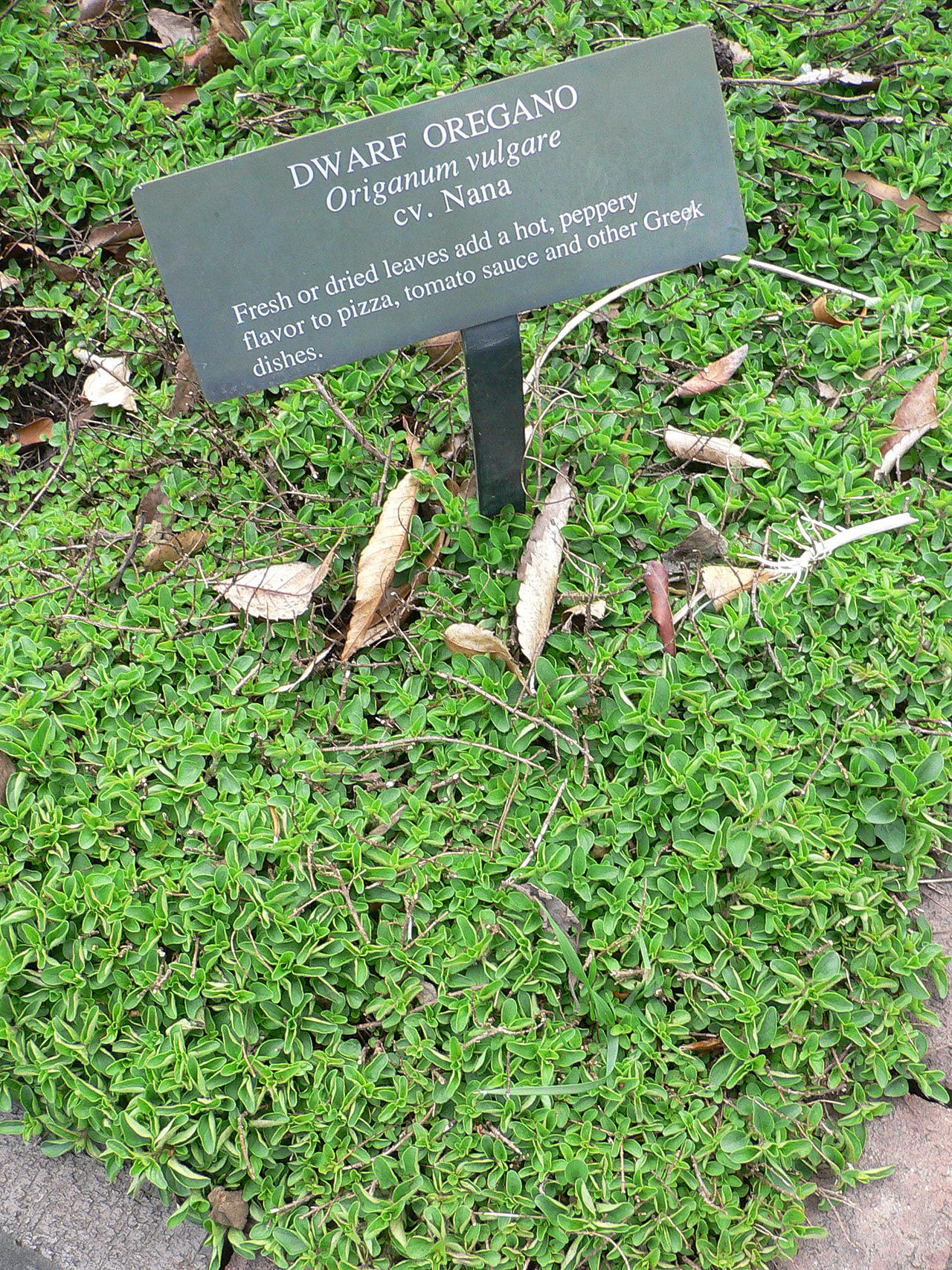
This card is Origanum vulgare only. Mexican oregano is Lippia graveolens, a different species. Sweet marjoram is Origanum majorana.
How it was found
Kew maps Origanum vulgare from Macaronesia to China. The native list is broad: Macaronesia, North Africa, most of Europe including Svalbard, Caucasus, Siberia, Middle Asia, China, Taiwan, Himalaya, India, Myanmar, Afghanistan, Iran, Iraq, Türkiye, Cyprus, and more. Introduced into parts of North America (including California), Mexico Southwest, New Zealand South, Venezuela, and Primorye. USDA GRIN’s native table is similarly Eurasian–Macaronesian (Canaries and Madeira native; Azores uncertain).
Kew lists California among regions into which O. vulgare is introduced. That is an undated distribution status, not a Mission landing and not a first-California year. UCCE Tuolumne prints only present-day California use: here in California, oregano is grown and used for flavorful herbs, ornamental landscaping and herbal remedies.
UC Sonoma writes that common O. vulgare grows wild in Mediterranean mountainous regions — a narrower statement than Kew’s Macaronesia-to-China list. UCCE Tuolumne: oregano and marjoram are native to the Mediterranean region. Those UC sentences are not Kew’s full native list. No fetched page printed a first-cultivation date or a single domestication center. UCCE Tuolumne writes that thousands of years ago, before the Mediterranean diet was labeled as such, oregano was a premier herb.
How people used it
Kew lists food (also invertebrate food). UC IPM: grown for aromatic leaves; can be used fresh or dried; Greek and Italian oregano are good culinary varieties. UC Sonoma: aromatic leaves used fresh or dried as seasoning; popular in Italian cuisine and pizza. UCCE Tuolumne: common oregano (O. vulgare) widely used for cooking; dried oregano is part of Italian, Mexican, Argentine, Turkish, Greek, Portuguese, and other Mediterranean cuisines; it may be used fresh or dried, with dried leaves having stronger flavor; used on meats, vegetables, fish, salads, and pizzas.
Kew lists medicine with no specific remedy named. UCCE Tuolumne chariot-race / Elizabethan-remedy lines are skipped. Riverside oregano fact sheet history lines cite Gardening Know How / SoftSchool and were not used.
Timeline
-
Thousands of years ago (as printed by UCCE Tuolumne)
A premier herb before the diet had a name
UCCE Tuolumne / Central Sierra Master Gardeners write that thousands of years ago, before the Mediterranean diet was labeled as such, oregano was a premier herb, and that oregano and marjoram are native to the Mediterranean region. That is UC’s span. Kew’s native map is wider than the Mediterranean.
UCCE Tuolumne / Central Sierra — Oregano: By Reputation Only
-
Greek (etymology, as printed)
Beauty of the mountain
UC Master Gardeners of Sacramento County write that the genus name Origanum probably comes from the Greek words oros (mountain) and gamos (beauty), “beauty of the mountain.” That is a name, not a first garden.
UC Master Gardeners of Sacramento County — Grow herbs!
-
1753
Named in Species Plantarum
Kew accepts Origanum vulgare L., first published in Sp. Pl.: 590 (1753). USDA GRIN: Sp. pl. 2:590. 1753. UCCE Tuolumne notes Linnaeus formalized the modern naming system — context for the 1753 name, not a crop-origin date.
Kew POWO; USDA GRIN; UCCE Tuolumne
Cool to know
UC Sonoma: Mexican oregano is Lippia graveolens, a completely different species, and is not a true oregano. This card is Origanum vulgare only.
UC Master Gardener Program of Sonoma County
UC Sonoma: Origanum vulgare hirtum is considered the true Greek oregano; O. vulgare syriacum is used in za’atar. Sweet marjoram is Origanum majorana, a different species.
UC Master Gardener Program of Sonoma County
USDA GRIN English common name printed for this taxon is wild marjoram (not “oregano”). UC IPM and UC Sonoma use oregano for O. vulgare. Same species, two kitchen names.
USDA GRIN; UC IPM; UC Sonoma
UC Sacramento: Origanum is a genus of about 20 species native to the Mediterranean and Southwest Asia; some are used as culinary herbs.
UC Master Gardeners of Sacramento County
UCCE Tuolumne / Central Sierra Master Gardeners print oregano as a pizza-topping herb (“like a pizza-topping herb”; “that pizza herb—oregano”). The Riverside fact sheet’s WWII-soldiers-brought-pizza-spice line cites SoftSchool and was not used.
UCCE Tuolumne / Central Sierra — Oregano: By Reputation Only
Growing notes for this plant live on the Plant Wiki. This page is origin and use, not a How-To.
Want oregano in a San Diego bed? See the easy-herbs guide for keeping culinary oregano going here. Get a quote or write yourgardenofgold@gmail.com.