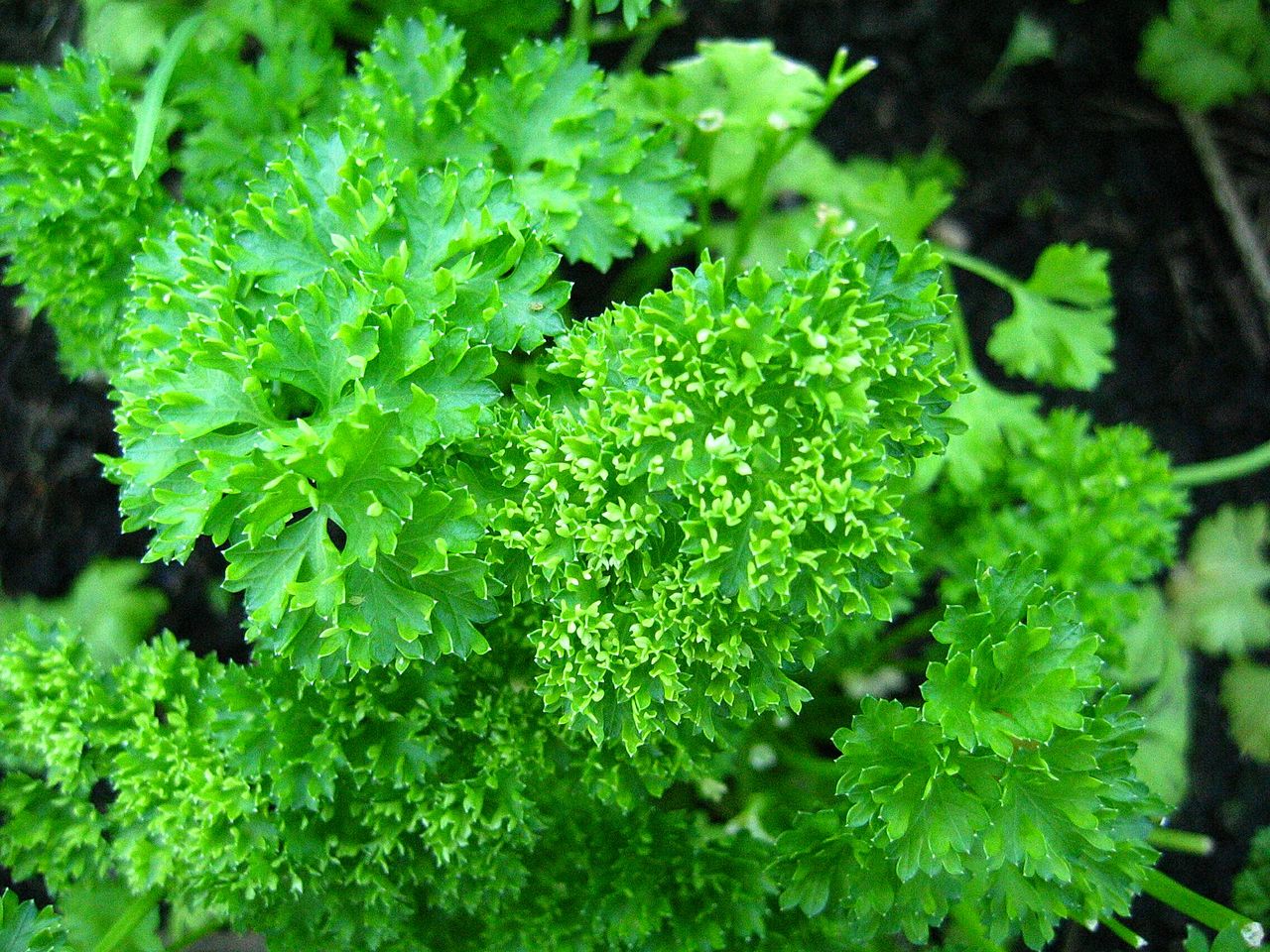
Petroselinum crispum is not Chinese parsley. Cilantro is Coriandrum sativum.
How it was found
Kew maps Petroselinum crispum as northwest Africa and the Balkan Peninsula. Native list: Algeria, Greece, Morocco, northwest Balkan Peninsula. Introduced widely across Europe, the Americas, parts of Africa, Asia, and islands — including California.
USDA GRIN does not print a native-country table; it lists the species as widely cultivated and widely naturalized. UC Marin: native to Mediterranean countries. Marin’s broader “Mediterranean countries” and Kew’s northwest Africa + Balkan Peninsula list are not identical.
No fetched page printed a first-cultivation date or a single domestication center.
How people used it
Kew lists food. UC Sacramento: used in stews, soups, sauces, dressings, and seasonings; curled parsley (P. crispum var. crispum) is the go-to garnish; Italian flat-leaf (P. c. var. neapolitanum) is said to have a stronger flavor that holds up better in cooking. UC Marin: curly leaf used more as a garnish and flat-leafed parsley used for cooking. UC Sonoma: extra parsley may be frozen or dried for long-term storage; start harvesting 60–75 days after planting; harvest from the outside of plants.
Kew lists medicine with no specific remedy named. GRIN folklore medicines are not copied. UC Sacramento’s “natural breath sweetener due to high chlorophyll” is a printed culinary aside, not copied as a folk-medicine recipe.
Timeline
-
Mediterranean native (as printed, no first-cultivation date)
Two maps, one herb
UC Marin Master Gardeners: native to Mediterranean countries. Kew’s native range is narrower: northwest Africa, Balkan Peninsula (Algeria, Greece, Morocco, northwest Balkan Peninsula). Both sentences stay. Neither is a first-garden year.
UC Marin Master Gardeners; Kew POWO
-
1866
The name this card uses
Kew accepts Petroselinum crispum (Mill.) Fuss, first published in Fl. Transsilv.: 254 (1866). USDA GRIN: Fl. transsilv. 254. 1866. GRIN synonyms include Apium petroselinum L., Petroselinum hortense Hoffm., and Petroselinum sativum Hoffm. ex Gaudin.
Kew POWO; USDA GRIN
-
Present (as printed)
Biennial that gardeners treat as annual
UC Sacramento: parsley is a biennial, growing during its first season and blooming during its second; many gardeners prefer to grow it as an annual. Two culinary types are treated under P. crispum: curled (var. crispum) and Italian flat-leaf (var. neapolitanum).
UC Master Gardeners of Sacramento County
-
Present (Sonoma, as printed)
Year-round harvest there
UC Master Gardener Program of Sonoma County: parsley may be harvested in Sonoma County year-round; a few plants started in spring usually last all winter there. For continued presence, set out new plants each year or allow an existing plant to reseed. That is a county-printed harvest window, not a first-cultivation date, not a California arrival, and not collapsed with Sacramento’s biennial-grown-as-annual line.
UC Master Gardener Program of Sonoma County — Parsley
Cool to know
UC Sacramento treats Italian flat-leaf as Petroselinum crispum var. neapolitanum. UC Marin prints a separate binomial Petroselinum neapolitanum for flat leaf. Kew and GRIN accept one species, P. crispum; GRIN flags var. neapolitanum Danert as nom. inval. Marin’s split is not Kew taxonomy.
UC Sacramento; UC Marin; Kew; USDA GRIN
Chinese parsley / cilantro is Coriandrum sativum (UC Sonoma; GRIN). This card is Petroselinum crispum.
UC Sonoma; USDA GRIN
UC Sacramento: biennial that sends up white flowers in the second summer, when leaf flavor turns bitter — the printed reason many gardeners grow it as an annual.
UC Master Gardeners of Sacramento County
UC Sonoma MG: expect parsley worms, larvae of the swallowtail butterfly, feeding on a few sprigs; larvae go through 5 stages from black/brown with orange markings and spines to smooth, pale green bodies with black and yellow stripes before emerging as yellow and black butterflies. Printed as a garden fact, not a use.
UC Master Gardener Program of Sonoma County — Parsley
Kew POWO habit is “biennial or perennial” of the temperate biome. UC Sacramento treats it as a biennial grown as an annual. Those two printed habits are neighboring, not identical — Kew’s “or perennial” is not collapsed into the Sacramento annual-practice beat.
Kew POWO; UC Sacramento
UC Sacramento MG prints a culinary aside that parsley is a natural breath sweetener due to its high chlorophyll content. Copied here as a printed aside, not as a folk-medicine recipe.
UC Master Gardeners of Sacramento County
Growing notes for this plant live on the Plant Wiki. This page is origin and use, not a How-To.
Want parsley in a San Diego pot? See the easy-herbs guide for keeping culinary parsley going here. Get a quote or write yourgardenofgold@gmail.com.