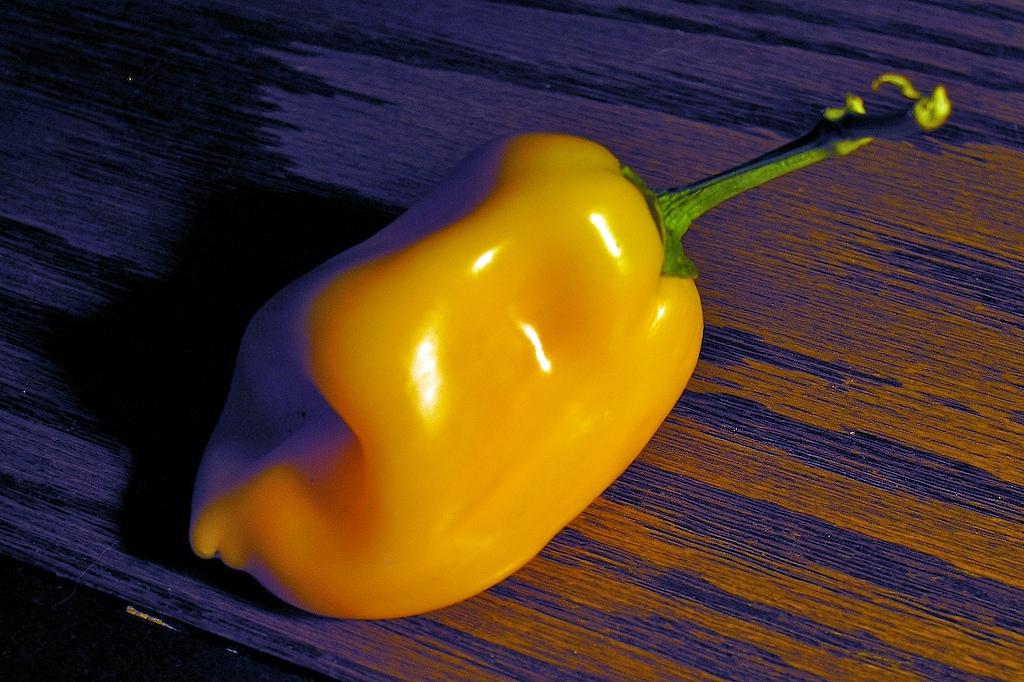
This story is Capsicum annuum only — not habanero (C. chinense), not Tabasco (C. frutescens), and not black pepper (Piper).
How it was found
Kew maps C. annuum from the southern United States to Brazil and the Caribbean. The native list includes southern U.S. states such as Alabama, Arizona, Florida, Louisiana, and Texas, plus Mexico, Central America, the Caribbean, and northern and western South America (Bolivia, Brazil, Colombia, Ecuador, Peru, Venezuela, the Guianas). The species is introduced widely in the Old World. USDA GRIN’s native table emphasizes Mexico, the southern U.S., the Caribbean, Central America, and Colombia, and notes the crop is widely cultivated.
UC pages tell a wild-to-garden story that is not identical to Kew’s map. UC Santa Cruz CASFS writes that C. annuum is thought to have originated with the wild chiltepin or chilipiquin in Bolivia and southern Brazil before the arrival of humans. UC Master Gardeners of San Diego County write that archaeological evidence points to the Amazon basin (regions now straddling Bolivia and Brazil) as the birthplace of the chile, and that roughly 7,000 years ago central Mexico became the epicenter of domestication. UCCE El Dorado adds that C. annuum and cousins C. frutescens and C. chinense are believed to have evolved from a common ancestor in South America.
Those sentences stay separate. Wild origin in the Amazon / Bolivia–Brazil chiltepin is not the same claim as Mesoamerican domestication. No single country of origin is treated as settled here.
How people used it
Kew lists food and a food additive. UCCE San Bernardino writes that C. annuum is native to the Americas and that chiles are a traditional staple there with corn, beans, squash, potatoes, and quinoa. After European contact the fruit was transported abroad, and for more than five centuries varieties have been cultivated worldwide.
Kew also lists unspecified medicinal disorders, poison, and medicine. The taxon page does not name a folk remedy, so this page does not invent one. No fiber use showed up on the fetched pages.
Timeline
-
Before people in the Americas (as printed)
Wild chiltepin
UC Santa Cruz CASFS (Orin Martin) writes that Capsicum annuum is thought to have originated with the wild chiltepin or chilipiquin in Bolivia and southern Brazil before the arrival of humans. That is a wild-origin sentence. It is not Kew’s native-range list, and it is not the later Mexico domestication date.
UC Santa Cruz CASFS — Peppers From Sweet to Fiery
-
Roughly 7,000 years ago
Central Mexico domestication
UC Master Gardeners of San Diego County write that central Mexico became the epicenter of chile domestication roughly 7,000 years ago. That is the packet’s dated domestication center for the crop people actually grew. It sits after the wild South American origin on UC pages, not instead of it.
UC Master Gardeners of San Diego County — Chiles’ Spicy Heritage
-
First European contact / five centuries
Carried abroad
UCCE San Bernardino Master Gardeners write that from the first European contact the fruit was transported abroad, and that for more than five centuries varieties of peppers have been cultivated worldwide. That is how a New World staple became a global kitchen crop — still C. annuum, still not black pepper.
UCCE San Bernardino — Let’s Grow Chiles!
-
1753
Named in Species Plantarum
Kew and USDA GRIN print Capsicum annuum L. in Species Plantarum (GRIN: Sp. pl. 1:188–189. 1753). That is the accepted name for this story. Habanero and Tabasco stay on other Capsicum species.
Kew POWO; USDA GRIN
-
Since World War II
Sweet bells are a breeding product
UC Santa Cruz CASFS writes that there is no such thing as a sweet pepper in the wild — they are a product of human-directed plant breeding — and that sweet bell peppers have “virtually exploded on the scene since World War II.” Mild fruit is recent. Hot fruit is the older garden story.
UC Santa Cruz CASFS — Peppers From Sweet to Fiery
Cool to know
Genus Capsicum is New World (Solanaceae, with dominant centers in Central and South America — UC Santa Cruz CASFS). Black peppercorns are Piper, a different plant. UCCE El Dorado is explicit that they are unrelated.
UC Santa Cruz CASFS; UCCE El Dorado
C. annuum is the most widely grown pepper species and includes both sweet bells and hot types such as jalapeño. UC Master Gardeners of San Diego County, citing the Chile Pepper Institute, name five domesticated Capsicum species: annuum, chinense, frutescens, baccatum, and pubescens. This page is only the first.
UC Santa Cruz CASFS; UC Master Gardeners of San Diego County
The Latin annuum means annual, but in a hot climate a pepper plant is a perennial shrub. UCCE El Dorado prints that; UC Santa Cruz notes that annuum is a misnomer. The name describes a garden habit, not a wild life cycle.
UCCE El Dorado; UC Santa Cruz CASFS
Birds lack the TRPV1 receptors that make capsaicin painful to mammals, so they eat and disperse chile seeds (ornithochory). UC Master Gardeners of San Diego County print that as the reason birds, not mammals, are the classic chile movers.
UC Master Gardeners of San Diego County
Growing notes for this plant live on the Plant Wiki. This page is origin and use, not a How-To.
Want peppers that finish in San Diego heat? See the harvest How-To for color change and heat timing. Get a quote or write yourgardenofgold@gmail.com.