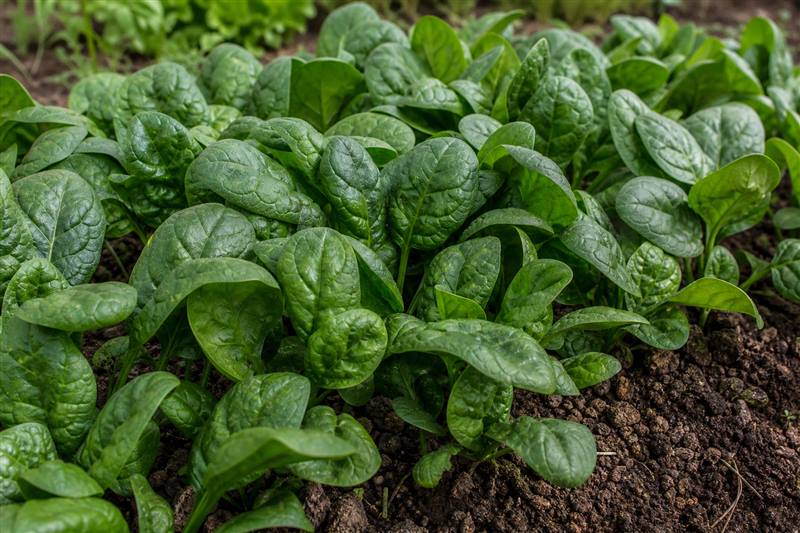
Spinacia oleracea is not New Zealand spinach, Malabar spinach, or water spinach. Skip the Wikipedia-sourced Persia / 647 AD / Popeye block on a Riverside fact sheet.
How it was found
Kew maps Spinacia oleracea from Iran to Central Asia and western Pakistan. Native list: Afghanistan, Iran, Kazakhstan, Kirgizstan, Pakistan, Tadzhikistan, Turkmenistan, Uzbekistan. Introduced widely, including California (undated on Kew — a distribution status, not a planting year). USDA GRIN: cultivated (only cult.) plus “probable origin s.w. Asia” (Andersen & Torp 2011). Kew’s native list and GRIN’s “only cult. / probable origin s.w. Asia” are neighboring but not identical statements.
No fetched page printed a first-cultivation year or a California Mission arrival. A Riverside MG fact sheet’s Ancient Persia / 647 AD / 12th-century Spain / 14th-century England timeline cites Wikipedia and is skipped. UCCE lambsquarters article: spinach was introduced from southwest Asia in the 16th century (that page’s wording for when lambsquarters lost favor in Europe).
How people used it
Kew lists food. UC IPM: grown for the edible leaves; three main types — savoy (curly leaf), semi-savoy, and flat leaf. GRIN economic uses include human food, vegetable. UC ANR Publication 7212 / UC IPM weed-management: grown for fresh markets (field packed in bunches or lightly processed) and processing markets (frozen/canned). A typical fresh-market crop can be grown in 30 to 55 days (IPM weed page: 30 to 50); the same variety grown for a processor takes 70 to 120 days.
Kew lists medicine (no named remedy) and poison. GRIN folklore is not copied.
Timeline
-
16th century (as printed)
Southwest Asia into Europe
UCCE Weed Technology / lambsquarters article: Europeans once valued lambsquarters as a vegetable and fodder; it lost favor when spinach was introduced from southwest Asia in the 16th century. That is this packet’s European-arrival wording — not a Persia/647 AD line from Wikipedia.
UCCE — lambsquarters article
-
1753
Named in Species Plantarum
Kew accepts Spinacia oleracea L., first published in Sp. Pl.: 1027 (1753). USDA GRIN: Sp. pl. 2:1027. 1753. Kew also accepts infraspecifics S. oleracea subsp. oleracea and S. oleracea subsp. turkestanica. Habit on Kew: annual or biennial of the temperate biome.
Kew POWO; USDA GRIN
-
1940s–1959 (California breeding, as printed)
Iranian germplasm, Califlay, Race 2
UC CalAg (Paul G. Smith): primitive weedy spinach strains from Iran were completely immune to downy mildew and became sources for the immune variety Califlay and immune F1 hybrids; by 1958–59 Califlay was infected in California (Race 2). Immunity from Iranian spinach was simply inherited as a single dominant gene in those tests. Spinach is predominantly dioecious (separate male and female plants), so self-pollination is not normally possible.
UC CalAg — Downy mildew of spinach / Iranian germplasm
-
Present California production (as printed, no first-planting year)
Four districts, Monterey nearly half
UC ANR Publication 7212 (LeStrange, Koike, Valencia, Chaney): California produces spinach in four areas — southern desert valleys (Imperial and Riverside), southern coast (Santa Barbara and Ventura), central coast (Monterey, San Benito, Santa Clara, Santa Cruz), and central San Joaquin Valley (Stanislaus and Tulare). Almost half of California’s spinach acreage and production is in Monterey County. Produced all year in the coastal valleys. California is the principal U.S. spinach-producing state (early-1990s U.S. context printed there). Not a first-arrival year.
UC ANR Publication 7212 — Spinach Production in California
-
1989–2011 (California downy-mildew races, as printed)
New races, then resistant lines
UC IPM agriculture spinach downy mildew: from 1989 to 2011, races 4, 5, 6, 10, 11, and 12 occurred and caused significant damage to spinach in California. During the past 50 years in California, each outbreak of a new downy mildew race was later matched by the development of resistant spinach lines. This continues the 1940s–1959 Iranian-germplasm / Califlay / Race 2 story; it is not collapsed with it.
UC IPM — Downy mildew / Spinach (agriculture)
Cool to know
UC IPM: family Amaranthaceae (amaranth family); three types savoy, semi-savoy, and flat leaf. Riverside MG fact sheet still heads the crop under Chenopodiaceae (beet, chard, spinach) — older family placement, not treated here as a second plant. UC ANR 7212: savoy types primarily for fresh market, smooth types preferable for processing; all spinach varieties commercially grown in California are hybrids, primarily because disease and bolting resistance have been bred into them. Also classified by seed type (prickly or smooth); most commercial varieties are now smooth-seeded.
UC IPM; UC ANR 7212
GRIN prints probable origin southwest Asia and only cultivated; Kew prints a native range Iran–Central Asia–western Pakistan. Those are neighboring but not identical statements.
USDA GRIN; Kew POWO
UC CalAg: spinach is predominantly dioecious (separate male and female plants), so self-pollination is not normally possible; Iranian germplasm supplied downy-mildew immunity used in California breeding.
UC CalAg
Growing notes for this plant live on the Plant Wiki. This page is origin and use, not a How-To.
Want spinach in a San Diego bed? See the fall-garden How-To for cool-season timing here. Get a quote or write yourgardenofgold@gmail.com.