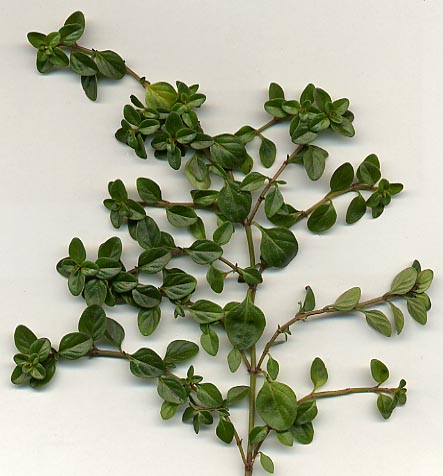
This card is Thymus vulgaris — common, English, or garden thyme. Lemon thyme and caraway thyme are different binomials on UC Marin’s page.
How it was found
Kew maps Thymus vulgaris as southwestern Europe and southeastern Italy. Native list: Balearic Islands, France, Italy, Spain. Introduced into Algeria, Belgium, Canary Islands, Cuba, Czechia-Slovakia, Dominican Republic, Germany, Great Britain, Haiti, Ireland, Leeward Islands, New Zealand South, Puerto Rico, and Switzerland.
USDA GRIN native: Morocco; Italy (southeast); Spain (including Balearics); France (south and Corsica); widely cultivated. GRIN lists Morocco as native; Kew does not. Those lists are not collapsed.
No fetched page printed a first-cultivation date or a single domestication center. UC Marin and UCCE SLO call it a Mediterranean native / from the Mediterranean region. That is a region, not a first garden year.
How people used it
Kew lists food. UC Marin: leaves and flowers edible; withstands cooking without losing flavor; used with sauces, meat, fowl, fish, seafood, and stuffing; one of the ingredients in herbs de Provence. UCCE SLO: tiny aromatic leaves used dry and fresh in stuffing, soups, seafood, and vegetable dishes. UC Master Gardeners of Santa Clara County: thyme is a popular seasoning in omelets, poultry dishes, stocks, stews, and salad dressings. USDA GRIN economic uses include food-additive flavoring and essential oils.
Kew lists medicine and also poison, with no specific remedy named. GRIN lists “Medicines — source of pharmaceutical agent (thymol)” with literature citations; those details are not copied as folk recipes. UCCE SLO’s indoor-burning plague-protection line is skipped.
Timeline
-
Greek (etymology, as printed)
Named for smoke
UCCE SLO Master Gardeners write that the name thymus is derived from the Greek word for smoke or fumigate. That is a name story. It is not used here as a plague-burning recipe; that SLO line was skipped.
UCCE SLO Master Gardeners — Thyme
-
1753
Named in Species Plantarum
Kew accepts Thymus vulgaris L., first published in Sp. Pl.: 591 (1753). USDA GRIN: Sp. pl. 2:591. 1753. That is common thyme, not lemon thyme.
Kew POWO; USDA GRIN
-
Present (as printed)
Herbs de Provence
UC Marin Master Gardeners: Mediterranean native sometimes called common or English thyme; culinary use of leaves and flowers; thyme is one of the ingredients in herbs de Provence. The blend is use, not a wild-origin date.
UC Marin Master Gardeners — Thyme
Cool to know
UCCE SLO: a low-growing shrubby perennial of the mint family from the Mediterranean region; leaves used dry and fresh. That is the garden habit this card is about.
UCCE SLO Master Gardeners
UC Marin lists lemon thyme as Thymus citriodorus and caraway thyme as Thymus herbabarona — not the same binomial as common/English thyme (Thymus vulgaris).
UC Marin Master Gardeners
USDA GRIN common names include thyme, common thyme, English thyme, and garden thyme; economic uses include flavoring and essential oils.
USDA GRIN
UC Master Gardeners of Santa Clara County: there are over three hundred varieties of thyme, but English thyme is the one most commonly grown for culinary use; French thyme has a similar, slightly milder taste.
UC Master Gardeners of Santa Clara County — Thyme
UC Master Gardener Program of Sonoma County: common thyme (vulgaris), sometimes called English or garden thyme, has a robust flavor that makes it one of the most popular types of thyme for culinary use; T. vulgaris ‘French’ is said to be slightly sweeter and milder than the plain species.
UC Master Gardener Program of Sonoma County — Thyme
Growing notes for this plant live on the Plant Wiki. This page is origin and use, not a How-To.
Want thyme in a San Diego pot? See the easy-herbs guide for keeping culinary thyme going here. Get a quote or write yourgardenofgold@gmail.com.