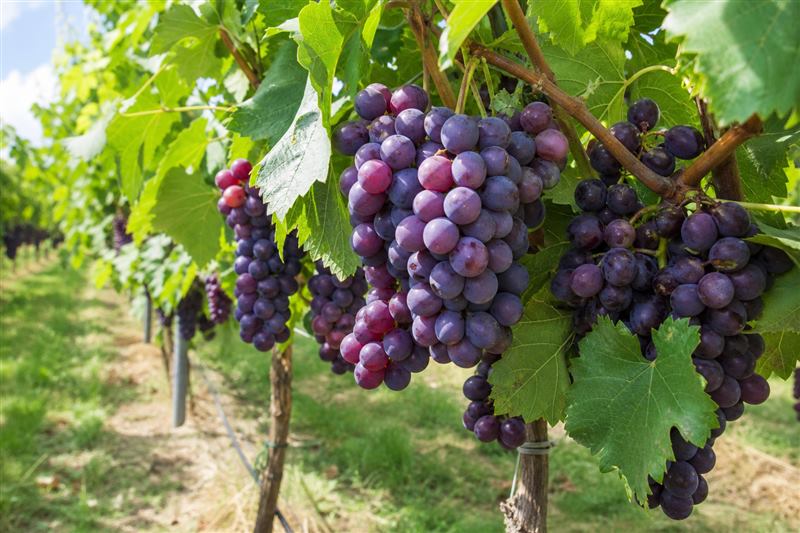
This card is Vitis vinifera, not Concord (V. labrusca), not muscadine, and not California native V. californica or V. girdiana.
How it was found
Kew maps Vitis vinifera from south-central and southeastern Europe to Central Asia and northern Iran. The native list runs from France, Italy, and Greece through Türkiye, the Caucasus, Iran, Iraq, and Middle Asia. USDA GRIN’s native table also includes Northern Africa (Algeria, Morocco) plus Caucasus, Middle Asia, Western Asia, and parts of Europe. Kew does not list Algeria/Morocco as Native to — GRIN’s North Africa natives are not collapsed onto Kew’s list. Related species (not this card): Kew accepts Vitis labrusca L. with native range southeastern Canada to eastern U.S.A.
Kew does not print a first-cultivation year. UC Postharvest grape chapter: V. vinifera is thought to originate in the Caucasus Mountains. UCCE Chen: three accepted regions of origin for the genus Vitis — Middle East (V. vinifera and V. jacquemontii), Asia, and North America; wild ancestor of today’s grapevines printed as Vitis vinifera ssp. sylvestris. UCCE Table Grapes webinar (Chen): grapevines were first domesticated around 8,000 BCE in the regions around the Caspian Sea. UC ANR Topics in Subtropics (Cornell/UC Davis grape-sex paper recap): “since the domestication of the grapevine 8,000 years ago.” 8,000 BCE and 8,000 years ago are not the same statement — both are printed, neither collapsed. Kew treats Vitis vinifera silvestris Vill. as a synonym of V. vinifera.
California arrival is printed on grape pages, not borrowed from fig. UC ANR Publication 21577 (Merenlender & Crawford): grapevines have been cultivated in California since the late 1700s, when Spanish missionaries brought European vines with them to ensure a supply of quality wine — that page does not print 1769. M. Andrew Walker (UC Davis viticulture, hosted on UC ANR): Spanish missionaries brought viticulture to San Diego in 1769 with the first of a series of Missions that finished with the Sonoma Mission in 1823; the first V. vinifera grapes planted from San Diego to Sonoma became known as Mission. UCCE San Diego County: San Diego was the first area where vineyards were planted and wine produced; the county’s viticulture legacy reaches back into the 18th and 19th centuries on San Diego Mission lands, with no single year on that page. 1769, late 1700s, and 18th–19th centuries stay as three printed sentences.
How people used it
Kew lists food (also animal food, fuel, social uses). UC Postharvest: V. vinifera is the dominant species for wine, fresh fruit or drying. UCCE Chen: V. vinifera used for table, raisin, and wine grapes — “the one all around us in California.” Kew also lists fuel, with no named fuel product on the taxon page.
Kew: used to treat unspecified medicinal disorders and as a medicine (no named folk remedy).
Timeline
-
Around 8,000 BCE (as printed by UCCE Chen webinar)
Caspian domestication, likely table first
UCCE Table Grapes webinar (Chris Chen): grapevines were first domesticated around 8,000 BCE in the regions around the Caspian Sea. Same deck: first domesticated grapes were likely used as table grapes; winegrapes delineated around the same time. This is not collapsed with the “8,000 years ago” sentence on another UC page.
UCCE Chen — Table Grapes webinar (2025)
-
8,000 years ago (as printed by UC ANR Topics in Subtropics)
Perfect flowers, two gene pools
UC ANR Topics in Subtropics recap of a Cornell/UC Davis PNAS paper: wines and table grapes exist thanks to hermaphroditic flower recombinations; “since the domestication of the grapevine 8,000 years ago.” Most cultivated grapevines are hermaphroditic; wild Vitis have only male or female flowers. This span is not treated as the same number as 8,000 BCE.
UC ANR Topics in Subtropics — The Perfect Flower
-
1753
Named in Species Plantarum
Kew accepts Vitis vinifera L., first published in Sp. Pl.: 202 (1753). USDA GRIN: Sp. pl. 1:202. 1753. Kew also accepts related Vitis labrusca L., Sp. Pl.: 203 (1753), as a different species. Habit on Kew: a liana of the temperate biome.
Kew POWO; USDA GRIN
-
Late 1700s (as printed)
Spanish missionaries, European vines
UC ANR Publication 21577 (Merenlender & Crawford, Vineyards in an Oak Landscape): grapevines have been cultivated in California since the late 1700s, when Spanish missionaries brought European vines with them to ensure a supply of quality wine. That page does not print 1769. The year 1769 is a separate Walker statement and is not collapsed here.
UC ANR Publication 21577
-
1769 (as printed by Walker)
Mission grape to San Diego
M. Andrew Walker (Department of Viticulture and Enology, UC Davis), paper hosted on UC ANR: Spanish missionaries brought viticulture to San Diego, California, in 1769 with the first of a series of Missions that finished with the Sonoma Mission in 1823. The first V. vinifera grapes planted from San Diego to Sonoma became known as Mission and were the primary V. vinifera cultivar until the 1840s Gold Rush. This is a grape-specific printed year, not copied from the fig packet.
Walker (UC Davis) — UC Davis’ Role in Improving California’s Grape Planting Materials
-
18th and 19th centuries (as printed)
First vineyards on Mission lands
UCCE San Diego County: San Diego was the first area where vineyards were planted and wine produced; the county’s viticulture and viniculture legacy reaches back into the 18th and 19th centuries on San Diego Mission lands. No single year is printed on this page.
UCCE San Diego County — How To Navigate The Grape Production Landscape
-
1840s Gold Rush (as printed)
Mission acreage, then north
Walker (UC Davis, UC ANR-hosted): Mission was the primary V. vinifera cultivar until the 1840s Gold Rush; Mission acreage expanded in the southern state to meet immigrant wine needs; viticulture also began moving north into the Sierra Nevada Foothills and into Sonoma and Santa Clara Counties.
Walker (UC Davis) — UC ANR intvit
Cool to know
UCCE Chen: nearly all grapes grown for food, wine, juice or raisins are one of two species — V. vinifera or V. labrusca. V. vinifera is the most common in cultivation, with over 10,000 unique cultivars, grouped as wine, table, and raisin. Concord-type V. labrusca is used mainly for jellies, jams, juice, and flavoring — a related species, not a hybrid formula invented here.
UCCE Chen — Common Grapevine Cultivars
UCCE Chen cultivar PDF: California native grapes are Vitis californica and Vitis girdiana — not this card. Muscadine is printed as Vitis/Muscadinia rotundifolia (“we don’t eat these here”). Rootstocks often come from V. rupestris, V. riparia, V. berlandieri — also not this card’s crop identity.
UCCE Chen — Common Grapevine Cultivars
UC ANR Topics in Subtropics: most cultivated grapevines are hermaphroditic; wild Vitis have only male or female flowers. Two independent recombinations produced the “perfect flower”; cabernet types vs pinot types trace to different gene pools; chardonnay and riesling carry both.
UC ANR Topics in Subtropics
UC IPM Pierce’s disease guideline lists Mission among cultivars with lower recovery (alongside Barbera, Chardonnay, Fiesta, and Pinot noir), versus higher recovery in Chenin blanc, Sylvaner, Ruby Cabernet, and White Riesling. A cultivar-name fact, not a history date.
UC IPM — Pierce’s disease / Grape
Growing notes for this plant live on the Plant Wiki. This page is origin and use, not a How-To.
Want grapevines in a San Diego yard? See the fruit-tree How-To for choosing crops in this climate. Get a quote or write yourgardenofgold@gmail.com.