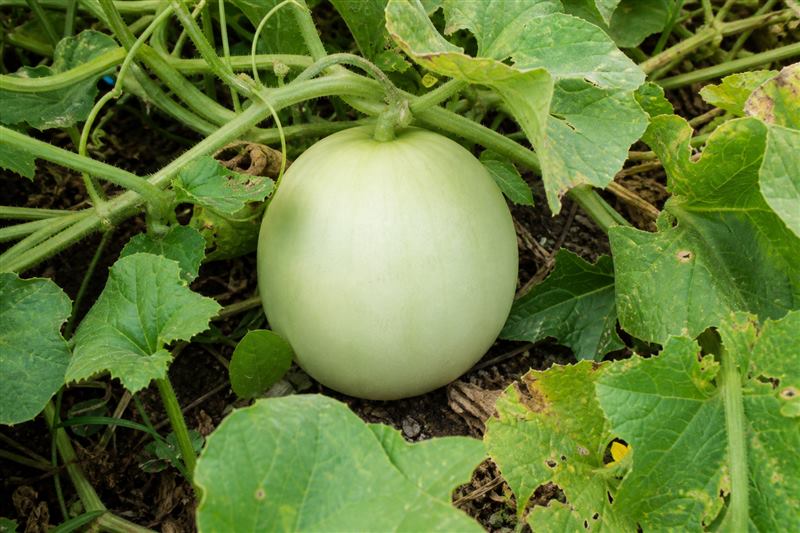
Armenian cucumber is this species, not Cucumis sativus. Watermelon is Citrullus lanatus, a different genus.
How it was found
Kew maps Cucumis melo from Ethiopia to southern Africa, southwestern Syria to the Arabian Peninsula and the Indian Subcontinent, and New Guinea to northern and central Australia. The native list is long: Afghanistan through much of Africa, India, Iran, Iraq, the Arabian Peninsula, Pakistan, and Australia among others. Introduced widely, including California. USDA GRIN’s native table is Africa-heavy. Kew’s Native list is broader than UC’s “originated in Africa” sentence — they are not collapsed.
Kew does not print a first-cultivation year. UC ANR Publication 8095: cantaloupes (C. melo) are thought to have originated in Africa and were brought to North America in approximately the sixteenth century. UCCE Solano: C. melo cucumber-melons are believed to originate from Ancient Egypt and were grown in Africa and Europe prior to the introduction of C. sativus. Those statements are not identical.
How people used it
Kew lists food (also animal food, invertebrate food, fuel, environmental and social uses). UC ANR 8095: U.S. “cantaloupe”/muskmelon is C. melo var. reticulatus (netted rind, orange flesh); honeydew, crenshaw, casaba, and Persian melons are also in the gourd family on that page. UCCE Solano: honeydew, cantaloupe, and Casaba are members of C. melo (muskmelons); Carosello/Armenian-type cucumber-melons are C. melo harvested immature as a vegetable.
Kew lists medicine and poison with no specific remedy named.
Timeline
-
Ancient Egypt (as printed by UCCE Solano)
Cucumber-melons before garden cucumber
UCCE Solano Master Gardeners: C. melo cucumber-melons are believed to originate from Ancient Egypt and were grown in Africa and Europe prior to the introduction of garden cucumber (C. sativus). That is why Armenian/Carosello stays on C. melo.
UCCE Solano — When is a Cucumber Not a Cucumber?
-
9th century (C. sativus contrast, as printed)
Garden cucumber arrives in Europe
UCCE Solano: C. sativus originated in the Indian subcontinent and was introduced to Europe in the 9th century; its tougher skin and cooler-climate adaptability let it surpass C. melo cucumber-melons in popularity. The contrast keeps Armenian/Carosello on C. melo, not C. sativus.
UCCE Solano — When is a Cucumber Not a Cucumber?
-
Approximately the sixteenth century
Cantaloupes to North America
UC ANR Publication 8095: cantaloupes (C. melo) were brought to North America in approximately the sixteenth century. Thought to have originated in Africa on that page — a narrower origin sentence than Kew’s broad native list.
UC ANR Publication 8095
-
1753
Named in Species Plantarum
Kew accepts Cucumis melo L., first published in Sp. Pl.: 1011 (1753). USDA GRIN: Sp. pl. 2:1011. 1753. One species for netted muskmelon and cucumber-melon alike.
Kew POWO; USDA GRIN
Cool to know
Wave 1 already printed that Armenian cucumber is Cucumis melo, not C. sativus. UCCE Solano repeats that Carosello Leccese is C. melo (cucumber-melon); honeydew, cantaloupe, and Casaba are also C. melo and can cross-pollinate.
UCCE Solano
UC ANR 8095: U.S. “cantaloupe” is C. melo var. reticulatus (netted muskmelon). True cantaloupes (C. melo var. cantaloupensis), commonly grown in Europe, have a rough scaly hard rind with no netting. Both are the same species, not watermelon and not cucumber. UC IPM: Cucumis melo var. cantalupo; muskmelons including cantaloupe and honeydew.
UC ANR 8095; UC IPM
UC Kearney watermelon page: watermelon (Citrullus lanatus) is a relative of melons (Cucumis melo) — different genus. Do not treat cantaloupe, honeydew, Casaba, Crenshaw, or Armenian/Carosello as different species; fetched UC pages place them in Cucumis melo.
UC Kearney; UCCE Solano; UC ANR 8095
Growing notes for this plant live on the Plant Wiki. This page is origin and use, not a How-To.
Want melon in a San Diego bed? See the seed-starting How-To for planting in this climate. Get a quote or write yourgardenofgold@gmail.com.