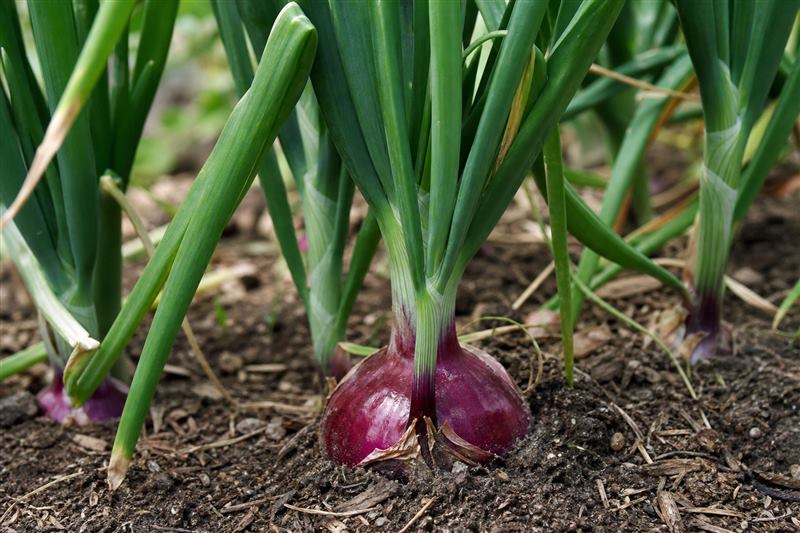
This card is Allium cepa, the bulb onion — not chives, garlic, leek, elephant garlic, or a shallot crop card.
How it was found
Kew maps Allium cepa as a cultigen from Central Asia. Native list printed: Turkmenistan. Introduced widely (including California). USDA GRIN: cultivated in Africa, temperate and tropical Asia, Europe, Australia, Canada, Mexico, the United States, and parts of South America — no Native status table.
UC Santa Cruz CASFS: cultivated onions thought native to Central and Southwest Asia — Iran, Afghanistan, and Pakistan. Tahoe Basin UCCE MG: bulb onion thought to have evolved in Iran or central Asia; no ancestral form of A. cepa found in the wild. Santa Clara MG: origin Western Asia. Napa MG: cultivation about six thousand years, likely somewhere in Asia or northern Africa. These are not identical statements, and Egypt-use dates are not collapsed into a single origin country.
Tahoe UCCE MG (citing Fritsch & Friesen 2002 as printed): thought domesticated by multiple peoples at least 5000 years ago. UC Santa Cruz: evidence of cultivated onions dates back to 2,800–3,200 BC in Egypt (pyramid decoration and hieroglyphics; bulbs used in embalming/mummification). Santa Clara MG: eaten in Egypt before 3000 B.C.
How people used it
Kew lists food (also animal food). UCCE Stanislaus: alliums have seasoned food for thousands of years; onions and garlic were two of the most important crops consumed in ancient Egypt. UC Santa Cruz: indispensable culinary bulb (soups, stews, stocks, sauces); tunicate/laminate bulb of swollen leaf bases. Santa Clara MG: used for food since very early times; flavoring in nearly every current world culture.
Kew lists medicine with no named remedy. GRIN folklore, Napa indigestion/blisters/dog-bite lines, and Tahoe antiseptic-ointment / WWII lines are skipped.
Timeline
-
2,800–3,200 BC / before 3000 B.C. (as printed)
Egypt: food, pyramids, mummies
UC Santa Cruz CASFS: evidence of cultivated onions dates back to 2,800–3,200 BC in Egypt (pyramid decoration and hieroglyphics; bulbs used in embalming and mummification). Santa Clara MG: eaten in Egypt before 3000 B.C. Tahoe UCCE MG: key food staple in Egypt during both the old and new kingdoms; used in mummification (small onions replaced eyes). Use in Egypt is not Kew’s Central Asia cultigen sentence.
UC Santa Cruz CASFS; Santa Clara MG; Tahoe UCCE MG
-
At least 5000 years / about six thousand years (as printed; not collapsed)
Domesticated more than once
Tahoe UCCE MG: thought domesticated by multiple peoples at least 5000 years ago. Napa MG: onion cultivation about six thousand years, likely Asia or northern Africa. These are UC wordings, not Kew dates, and they are not treated as one number.
Tahoe UCCE MG; Napa MG
-
1493 / 1634 / 1640 (as printed)
Isabella, Pilgrims, Iroquois
Tahoe Basin UCCE MG: Columbus planted onions on Isabella in 1493; by 1634 the Pilgrims were raising onions for food and trade; Iroquois tribes were growing onions (native and European) in New York by 1640. Three printed landings, not one American origin.
Tahoe Basin UCCE MG — Spring Planting of Onions
-
1753
Named in Species Plantarum
Kew accepts Allium cepa L., first published in Sp. Pl.: 300 (1753). USDA GRIN: Sp. pl. 1:300. 1753.
Kew POWO; USDA GRIN
-
1933 (as printed)
Grano 502, parent of sweet short-days
Tahoe Basin UCCE MG: in 1933 the Grano 502, parent of nearly all short-day sweet onions, was trialed by Texas A&M and the U.S. Department of Agriculture. A breeding parent, not a wild ancestor — Tahoe still prints that no ancestral form has been found in the wild.
Tahoe Basin UCCE MG
Cool to know
Santa Clara MG: Cepa (single bulb onion from seed), Aggregatum (shallot, multiplier, potato onion), Proliferum (Egyptian/tree onion). This card is the bulb onion (Cepa group). Shallot naming disagrees on Tier-1 pages (Aggregatum vs A. ascalonicum vs A. oschaninii vs GRIN common name of A. cepa) — this story is not a shallot crop card.
UC Master Gardeners of Santa Clara County
UC Santa Cruz: bulb initiation depends on day length (short / intermediate / long / very long day) and temperature; northern gardeners above about the 40th parallel grow long-day types. Santa Clara: short-day vs long-day split roughly San Francisco–Washington, D.C.
UC Santa Cruz CASFS; Santa Clara MG
Tahoe UCCE MG: no ancestral form of A. cepa has been found in the wild. Napa MG: uncut bulbs emit no smell; cutting releases sulfur compounds (odor) and a separate enzyme produces tear-causing fumes.
Tahoe UCCE MG; Napa MG
Growing notes for this plant live on the Plant Wiki. This page is origin and use, not a How-To.
Want bulb onions in a San Diego bed? See the seed-starting How-To for planting in this climate. Get a quote or write yourgardenofgold@gmail.com.