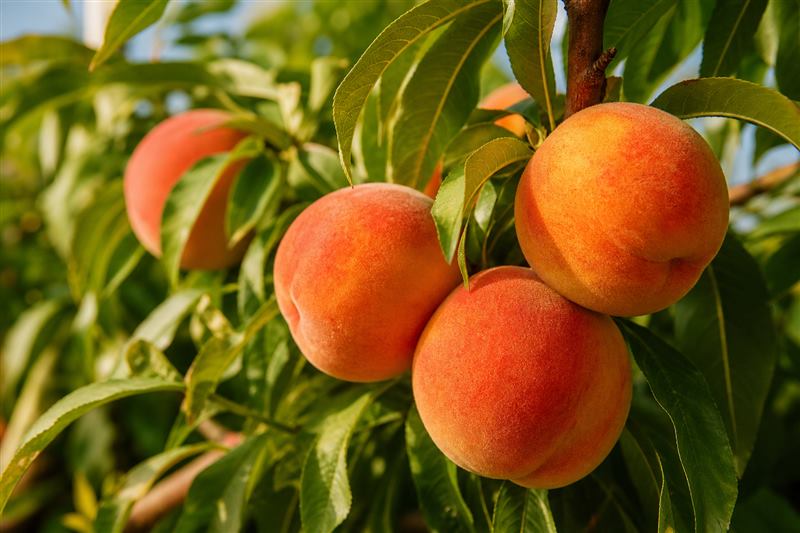
Prunus persica includes nectarine. Kew synonymizes var. nectarina with the species. Apricot, plum, and almond are related Prunus, not this card.
How it was found
Kew maps Prunus persica as a cultigen from north-central China. Native list printed: China North-Central. Introduced widely, including California. USDA GRIN prints Cultivated (only cult.) and Other: probable origin northern China — no native-country table. Kew’s Native to list is the cultigen statement plus China North-Central, not a wild multi-country range.
UC Kearney/Crisosto (The Peach, ch. 22): native to China; Chinese literature dates cultivation in China to 1000 BC; probably carried from China to Persia (Iran), then quickly to Europe; 16th century established in Mexico, probably by the Spaniards; 18th century Spanish missionaries introduced it to California. UC Bug Squad: nectarines originated in ancient China, not Persia, despite persica / nucipersica names. The China-cultigen statements agree on region; the 1000 BC date is UC’s, not Kew’s. persica / “Persian apple” is a name-history, not Kew Native to.
How people used it
Kew lists food (also fuel, environmental uses, invertebrate food). UC Kearney/Crisosto treats peach as a fresh-market stone fruit; UC IPM treats peaches and nectarines together as stone fruits grown in California.
Kew lists medicine and poison with no specific remedy named. GRIN folklore is not copied.
Timeline
-
1000 BC (as printed by UC)
Chinese literature, “Persian apple” later
UC Kearney/Crisosto: Chinese literature dates peach cultivation in China to 1000 BC; native to China; once called “Persian apple.” Kew prints a cultigen from north-central China with no year. The Persia in the name is the China-to-Persia route, not Kew’s native range.
UC Kearney / Crisosto — Harvesting and Postharvest Handling of Peaches
-
16th century
Established in Mexico
UC Kearney/Crisosto: peaches were established in Mexico, probably by the Spaniards. A New World planting after the China-to-Persia-to-Europe path.
UC Kearney / Crisosto
-
1616 (nectarine in America, as printed)
Nectarines with the colonists
UC ANR Bug Squad: European colonists began growing nectarines in America as early as 1616. Same page: nectarines originated in ancient China, not Persia; botanical names Prunus persica and P. persica var. nucipersica.
UC ANR Bug Squad — In the Pink
-
18th century
Spanish missionaries, California
UC Kearney/Crisosto: Spanish missionaries introduced the peach to California in the 18th century, which became the most important production area after China and Italy. An 18th-century California arrival — not collapsed with grape’s 1769 / late-1700s sentences.
UC Kearney / Crisosto
-
1753 / 1801
From Amygdalus to Prunus
Kew accepts Prunus persica (L.) Batsch, first published in Beytr. Entw. Gewächsreich: 30 (1801). Homotypic synonym Amygdalus persica L., Sp. Pl.: 472 (1753). USDA GRIN: Beytr. Entw. Gewachsreich 30. 1801.
Kew POWO; USDA GRIN
Cool to know
Kew treats Prunus persica var. nectarina (Aiton) Maxim. as a synonym of P. persica. UC IPM files peach and nectarine on one Prunus persica card. UC Bug Squad: nectarine is a close variety of peach — a genetic mutation; P. persica var. nucipersica. GRIN lists P. persica var. nucipersica as a conspecific taxon.
Kew POWO; UC IPM; UC Bug Squad; USDA GRIN
The epithet persica points at Persia, but UC Bug Squad prints origin as ancient China, not Persia. UC Kearney likewise: native to China; once called “Persian apple” after the China-to-Persia route.
UC Bug Squad; UC Kearney
UC IPM: peaches and nectarines self-pollinate and have low winter chilling requirements (California home-and-landscape card).
UC IPM — Peach and Nectarine
Growing notes for this plant live on the Plant Wiki. This page is origin and use, not a How-To.
Want a peach tree in a San Diego yard? See the fruit-tree How-To for choosing trees in this climate. Get a quote or write yourgardenofgold@gmail.com.