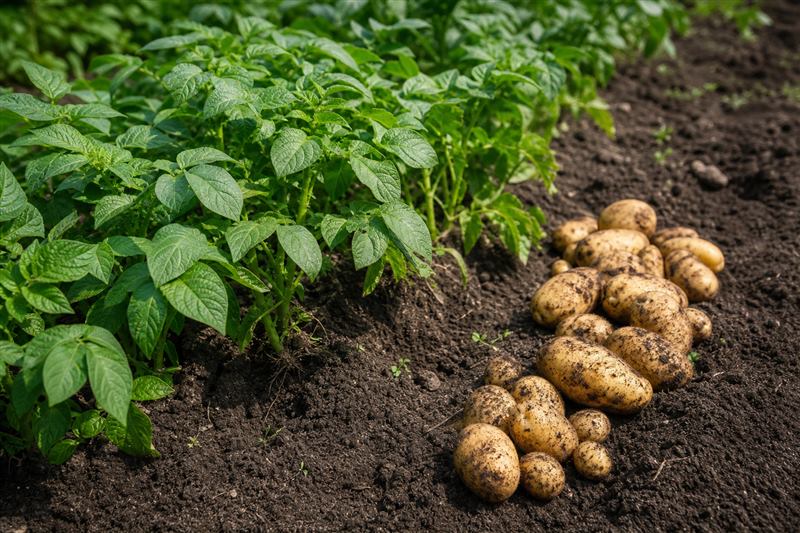
Solanum tuberosum: the edible part is a tuber — a modified stem — not a swollen root. Green tubers can carry toxic solanine; UC pages say discard them.
How it was found
Kew maps Solanum tuberosum from western and southern South America to northwestern Venezuela. Native list: Argentina Northwest and South, Bolivia, Chile Central, North and South, Colombia, Ecuador, Peru, Venezuela. Introduced into parts of Europe, Asia, Africa, and North America. USDA GRIN: widely cultivated; landraces listed for the Canary Islands, India, Mexico, Central America, Venezuela, Argentina, Chile, Bolivia, Colombia, Ecuador, and Peru. UC Marin / Tahoe UCCE / Placer-Nevada MG: native to the Andes of South America.
Tahoe Basin UCCE MG: cultivation by indigenous peoples goes back perhaps 10,000 years; European “discovery” first recorded in 1536 by conquistadores who found tubers in markets throughout the Incan Empire. Placer/Nevada UCCE MG: a native of the Andes, carried by Spaniards into Europe during the 16th century. Kew prints a South American native range, not a first-cultivation year. Riverside Just Fun Facts dates and a Yolo page that cites Charles C. Mann are not used as dated domestication consensus.
How people used it
Kew lists food (also animal food). Placer/Nevada MG: one of the world’s main food crops; edible portion is a tuber (modified stem); major source of starch, amino acids, protein, vitamin C, and B vitamins. Tahoe UCCE MG: chuño freeze-dried potato storage used by Andean peoples since before 1000 AD.
Kew lists medicine and poison with no named folk remedy. GRIN folklore is not copied. UC Marin MG: discard green potatoes, which contain a high level of toxic alkaloid solanine; exclude light in storage to prevent greening. Yolo UCCE Savvy Sage and El Dorado Master Food Preservers print the same safety point (solanine / glycoalkaloids). That is storage safety, not a historical medicine recipe.
Timeline
-
Perhaps 10,000 years / before 1000 AD (Andean, as printed)
Andes, chuño
Tahoe Basin UCCE MG: potatoes native to South America’s Andes; cultivation by indigenous peoples perhaps 10,000 years; chuño freeze-drying used by Andean peoples since before 1000 AD. Kew’s map is the Andes too. The freeze-dried store is how a highland tuber became year-round food.
Tahoe Basin UCCE MG — Potatoes workshop
-
1536 / 16th century
Into Europe with the Spaniards
Tahoe UCCE MG: European “discovery” first recorded in 1536 by conquistadores in Incan Empire markets. Placer/Nevada MG: Spaniards carried the potato into Europe during the 16th century.
Tahoe UCCE MG; UCCE Placer/Nevada
-
17th century (Ireland, as printed)
Ireland’s major food crop — routes not collapsed
Placer/Nevada UCCE MG: a century after the 16th-century introduction to Europe, the potato had become the major food crop in Ireland. Tahoe UCCE MG: Basque fishermen and/or secondary English introductions (Raleigh or Drake working for Raleigh) possibly brought it to Ireland — those routes are not collapsed into one.
UCCE Placer/Nevada; Tahoe UCCE MG
-
1621 / 1719 (English colonies, as printed)
Bermuda boxes, then New Hampshire
Tahoe Basin UCCE MG: first reports in the English colonies were a few boxes sent from the Governor of Bermuda to the Governor of Virginia in 1621; first potato crops planted in New Hampshire in 1719.
Tahoe Basin UCCE MG
-
1753
Named in Species Plantarum
Kew accepts Solanum tuberosum L., first published in Sp. Pl.: 185 (1753). USDA GRIN: Sp. pl. 1:185. 1753.
Kew POWO; USDA GRIN
-
1845–1849 (mid-1800s)
Late blight, famine
Tahoe UCCE MG: 1845–49 (52) the vast majority of the Irish potato crop failed; cause printed as late blight, Phytophthora infestans; about 1 million starved and 2 million migrated by 1855. Placer/Nevada MG: fungal disease caused the Irish potato famine in the mid-1800s.
Tahoe UCCE MG; UCCE Placer/Nevada
Cool to know
New World origin is printed on Kew (western and southern South America to northwestern Venezuela) and on UC pages (Andes). The edible part is a tuber — a modified stem — not a swollen root (Placer/Nevada MG; Tahoe MG).
Kew POWO; Placer/Nevada MG; Tahoe MG
Yolo UCCE Savvy Sage states sweet potatoes are morning-glory family (swollen roots), while potato is nightshade (Solanum) with tobacco, tomato, pepper, and eggplant. Do not mix Ipomoea batatas with Solanum tuberosum.
Yolo UCCE Savvy Sage
UC Marin MG / Savvy Sage: green tubers contain the toxic alkaloid solanine and should be discarded; keep tubers covered and stored dark to prevent greening. El Dorado Master Food Preservers: green color is chlorophyll from light; glycoalkaloid formation can coincide.
UC Marin; Yolo Savvy Sage; UCCE El Dorado Master Food Preservers
Growing notes for this plant live on the Plant Wiki. This page is origin and use, not a How-To.
Want potatoes in a San Diego bed? See the raised-bed How-To for planting space in this climate. Get a quote or write yourgardenofgold@gmail.com.