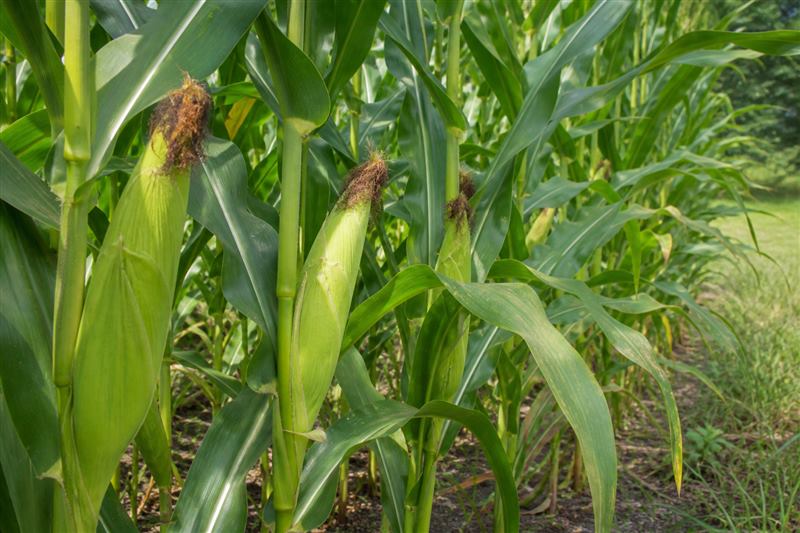
Wiki working name Zea mays var. saccharata is not Kew’s accepted taxon. Kew treats it as a synonym of cultivated Zea mays subsp. mays.
How it was found
Kew maps Zea mays from Central and southwestern Mexico to western Guatemala. Native list: Guatemala, Mexico Central, Mexico Southwest. Introduced very widely, including California and much of the U.S. USDA GRIN native table: Mexico (Chihuahua, Durango, Guanajuato, Jalisco, México, Michoacán de Ocampo) and Guatemala; also cultivated. Kew’s accepted cultivated subspecies Zea mays subsp. mays is printed as a cultigen from Mexico (N. Guerrero), Native to: Mexico Southwest — the cultivated maize/sweet-corn lineage, not a second species. Those two Kew sentences are not collapsed into one origin line.
Kew does not print a first-cultivation year on the Z. mays L. taxon page. UC Small Farms Network (1992): the oldest known remains of corn cobs may be in Tehuacan, Mexico, dating back 7,000 years; most corn historians consider a wild grass called teosinte one of modern corn’s primary ancestors. UC Marin: corn descended from a Mexican grass called teosinte — no year. A Riverside MG “9,000 years” line that cites Wikipedia is not used.
How people used it
Kew: used for food (also animal food, invertebrate food, fuel, environmental and social uses). UC Small Farms: maize was the foundation of most great Western Hemisphere civilizations (Incas, Mayans, Aztecs); sweet corn is one of six common kernel types of the same crop (flint, flour, dent, pop, waxy, and sweet). UC Marin MG: technically a grain, considered a fruit, commonly categorized as a vegetable; sweet-corn ears harvested for eating.
Kew lists medicine with no specific remedy named. GRIN folklore is not copied. GRIN’s secondary “Materials — fiber” row is not copied as a historical-use claim.
Timeline
-
7,000 years (as printed)
Tehuacan cobs, teosinte
UC Small Farms Network: the oldest known remains of corn cobs may be in Tehuacan, Mexico, dating back 7,000 years; teosinte is treated as one of modern corn’s primary ancestors. Kew’s species map is Central and southwestern Mexico to western Guatemala. The 9,000-year Wikipedia-cited line is not used.
UC Small Farms Network — Specialty Corn (1992)
-
Five hundred years ago / Columbus
Europeans meet maize
UC Small Farms Network: five hundred years ago Columbus was one of the first Europeans to set eyes on maize. A contact date, not a Mexican origin date.
UC Small Farms Network — Specialty Corn (1992)
-
1540
Coronado sees irrigated corn
UC Small Farms Network: Coronado noted maize or corn growing under irrigation among Native Americans of the southwestern part of what is now the United States.
UC Small Farms Network — Specialty Corn (1992)
-
1620
Pilgrim winter
UC Small Farms Network: corn largely kept the Pilgrims alive during the harsh winter of 1620 on the East Coast.
UC Small Farms Network — Specialty Corn (1992)
-
1753
Named in Species Plantarum
Kew accepts Zea mays L., first published in Sp. Pl.: 971 (1753). USDA GRIN: Sp. pl. 2:971. 1753. Sweet corn stays this species.
Kew POWO; USDA GRIN
Cool to know
Kew lists Zea mays var. saccharata (Sturtev.) L.H.Bailey and Zea saccharata Sturtev. as heterotypic synonyms of Zea mays subsp. mays (the cultivated maize cultigen). USDA GRIN likewise treats var. saccharata as a synonym of subsp. mays.
Kew POWO; USDA GRIN
UC Small Farms: six most common corn types are flint, flour, dent, pop, waxy, and sweet (plus pod/tunicate corn). Popcorns are basically small-kerneled flint types. They are kernel-endosperm classes of Zea mays, not separate species.
UC Small Farms Network
UC Small Farms: standard sweet corn at the immature milky stage contains about 10 percent sucrose, while field corn at the same stage has about 4 percent; a sugary gene retards conversion of sugar to starch. Later SH2 / SE types have 2 to 3 times as much sucrose as standard sweet corn at harvest.
UC Small Farms Network
UC Marin Master Gardeners: corn is in Poaceae; it descended from a Mexican grass called teosinte; wind-pollinated (tassel pollen onto silks, each silk fertilizing one kernel).
UC Marin Master Gardeners
Growing notes for this plant live on the Plant Wiki. This page is origin and use, not a How-To.
Want sweet corn in a San Diego bed? See the seed-starting How-To for planting in this climate. Get a quote or write yourgardenofgold@gmail.com.