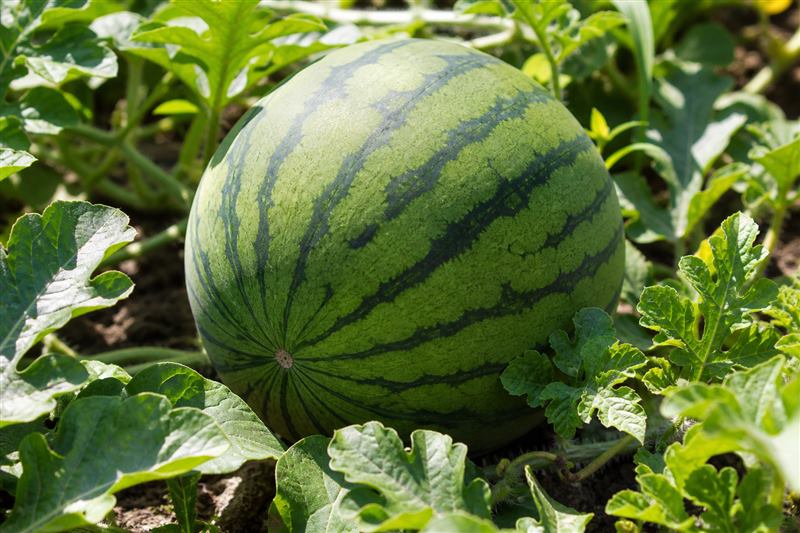
Citrullus lanatus is a different genus from cucumber (Cucumis sativus) and melon (Cucumis melo). Bitter colocynth is not this card.
How it was found
Kew maps Citrullus lanatus as eastern Sahara. Native list: Egypt, Ethiopia, Libya, Sudan-South Sudan. Introduced very widely, including California. Kew’s Species Profile on the same taxon: thought to be native to Africa; some propose the Kalahari region (Botswana, Namibia and South Africa), others northeastern Africa — those are printed as competing proposals, not as Kew’s Native to list. USDA GRIN native rows emphasize Egypt (south), Sudan, and Kenya (north); GRIN Other: probable origin western or northeastern Africa. Kew’s eastern Sahara Native list is not collapsed with the Kalahari or GRIN Kenya statements.
Kew Species Profile: it is thought that watermelon was first domesticated in central and southern Africa; origins are unknown after long cultivation. Same profile: it may have been selected from Citrullus colocynthis, while C. ecirrhosus is thought more likely to be the progenitor based on plastid DNA — hypotheses about other species, not this card. UC Kearney/UCCE Fresno: watermelons are considered to have originated in Africa. No single first-cultivation country is treated as settled.
How people used it
Kew lists food (also animal food, fuel, environmental and social uses). Kew Species Profile: widely cultivated for edible fruits and as a water source in arid regions of Africa; flesh consumed fresh; seeds eaten in some African and Asian cuisines. UC Kearney trial treats Citrullus lanatus as a fruit crop (seeded, seedless triploid, icebox, and mini types).
Kew lists medicine and poison with no named folk recipe. Kew Species Profile lists several traditional uses; those specific remedies are not copied. GRIN folklore is not copied.
Timeline
-
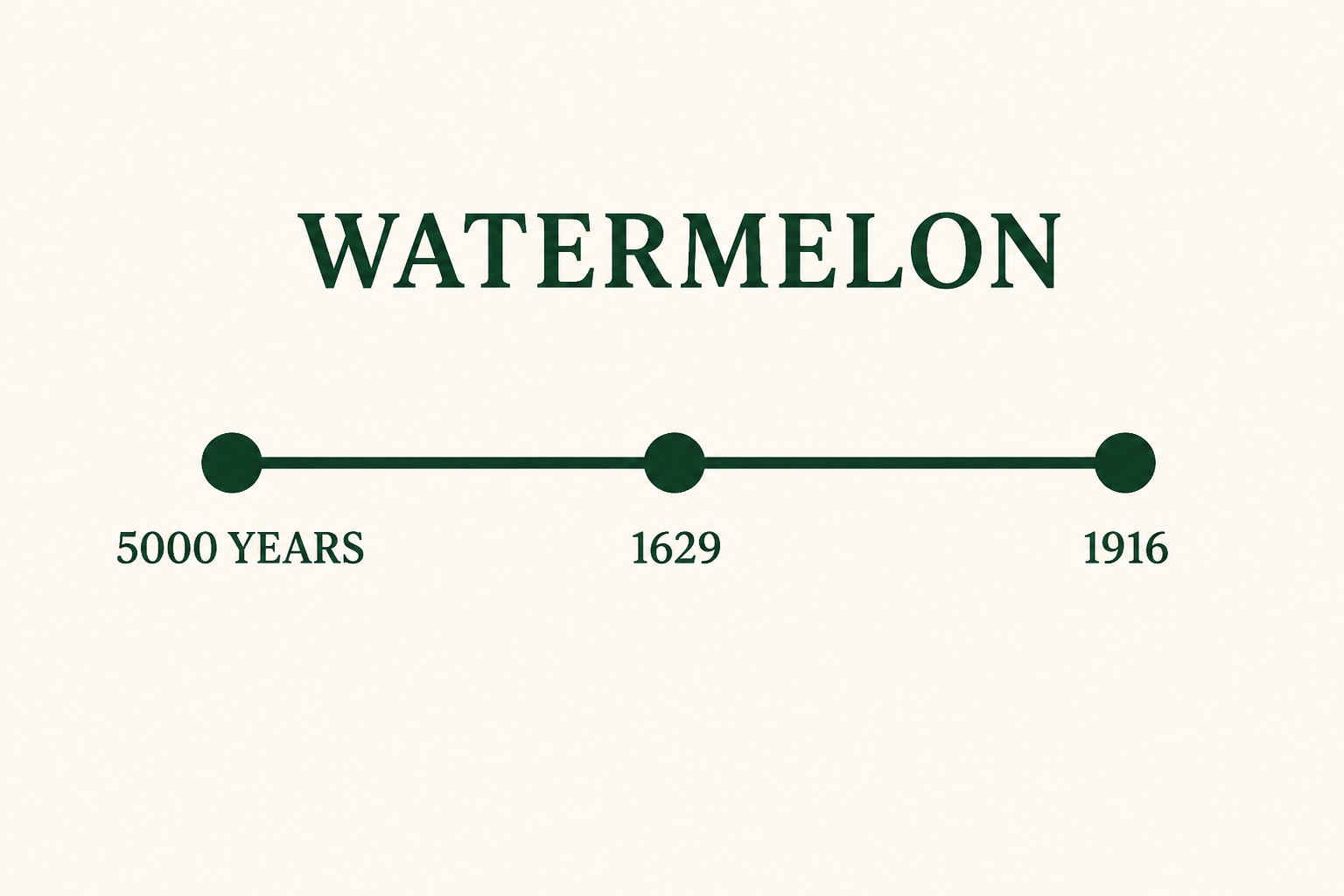
More than 5,000 years ago (as printed by Kew)
Egyptian tombs, African domestication
Kew Species Profile: watermelon seeds and leaves have been found in ancient Egyptian tombs, suggesting it was cultivated there more than 5,000 years ago; first domestication is printed as thought to be in central and southern Africa. Origins are unknown after long cultivation, on that same profile.
Kew POWO Species Profile — Citrullus lanatus
-
16th century
Across the Atlantic
Kew Species Profile: watermelon is native to Africa and did not reach the Americas until the 16th century. An Old World cucurbit, arriving after contact.
Kew POWO Species Profile
-
1629
Seeded watermelons in the U.S. market
UC Kearney/UCCE Fresno organic watermelon trial: older diploid (seeded) watermelons have been a major part of the U.S. market for many years (since 1629).
UCCE Fresno / UC Kearney — Organic Personal Watermelon Variety Trial (2006)
-
1916
The accepted name
Kew accepts Citrullus lanatus (Thunb.) Matsum. & Nakai, first published in Index Seminum (TI, Tokyo) 1915–1916: 30 (1916). Homotypic synonym Momordica lanata Thunb. (1794), nom. cons.
Kew POWO
-
1939
Seedless triploids in Japan
UC Kearney/UCCE Fresno: seedless (triploid) watermelons were first produced in Japan in 1939 — a diploid × tetraploid cross (2n=22 × 4n=44) yielding a sterile triploid. Large seedless types became popular in U.S. markets later (since 1988 on that PDF).
UCCE Fresno / UC Kearney (2006)
Cool to know
Kew Species Profile: watermelon is Cucurbitaceae with cucumbers (Cucumis sativus), melons (Cucumis melo), loofahs, and pumpkins/squashes (Cucurbita) as relatives — different genera. Epithet lanatus means woolly (hairs on young stems). Generic name Citrullus is printed as a diminutive of Citrus, perhaps referring to spherical fruit.
Kew POWO Species Profile
UC Kearney/UCCE Fresno: older diploid seeded (since 1629), large seedless triploids popular since 1988, icebox 6–12 lb, and seedless mini/personal melons widely available from 2003. Scientific name on that PDF: Citrullus lanatus.
UCCE Fresno / UC Kearney
Kew Species Profile: wild unselected forms tend to bear bitter fruit because of cucurbitacin; cultivated flesh is usually red or yellow, sometimes orange, pink or white; wild fruits much smaller than cultivated ones. Do not mix Citrullus colocynthis (bitter colocynth) or C. ecirrhosus as this card.
Kew POWO Species Profile
Growing notes for this plant live on the Plant Wiki. This page is origin and use, not a How-To.
Want watermelon in a San Diego bed? See the seed-starting How-To for planting in this climate. Get a quote or write yourgardenofgold@gmail.com.